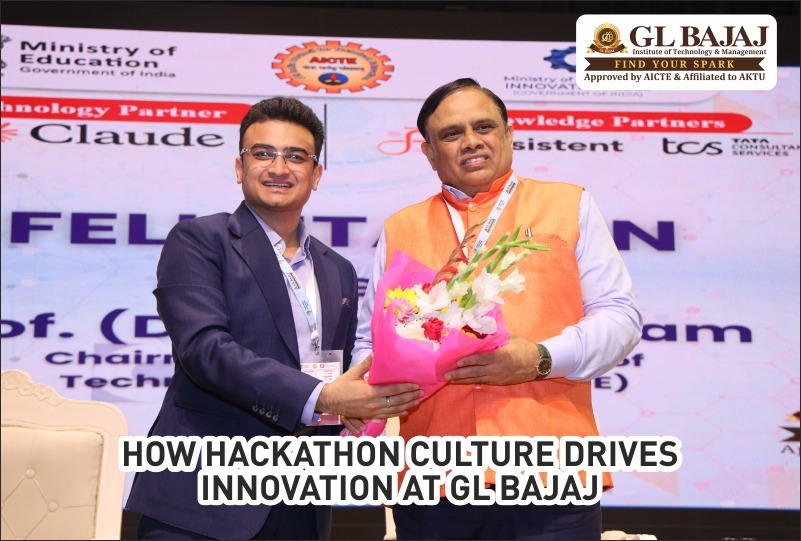
Innovation at GL Bajaj Institute of Technology & Management (GLBITM) is not limited to classroom discussions. It can be seen in student teams designing prototypes, testing new technologies and working together to solve real-world problems.
Hackathons have become an important part of this learning environment. Through national competitions, campus events, industry-supported programmes and faculty mentorship, students get opportunities to apply their technical knowledge in practical situations.
From hosting the Smart India Hackathon and Kavach to organising healthcare and technology-focused competitions, GL Bajaj has developed a strong innovation ecosystem.
These initiatives help students improve their technical abilities while also building creativity, teamwork, communication and problem-solving skills.
Building an Active Hackathon Ecosystem
A hackathon brings students together to develop a solution within a limited period. Participants must understand a problem, plan their approach, create a prototype and present it before experts.
This process helps students experience how technology projects work outside the classroom.
It also teaches them how to manage time, divide responsibilities, respond to feedback and improve an idea under pressure.
At GL Bajaj, hackathons are supported through:
- Faculty guidance and technical mentoring
- Interdisciplinary student teams
- Access to laboratories and development resources
- Collaboration with government and academic organisations
- Opportunities to work on real social and industrial challenges
- Support for taking promising ideas towards further development
Together, these elements create a continuous learning environment in which students can move from identifying a problem to building a useful solution.
GLBITM as a Smart India Hackathon 2025 Nodal Centre
A major milestone in this journey came in December 2025, when GL Bajaj Institute of Technology & Management was selected as one of 18 Hardware Edition Nodal Centres for the eighth edition of the Smart India Hackathon.
Smart India Hackathon, organised under the Ministry of Education’s innovation initiative, gives students an opportunity to create technology-based solutions for challenges shared by government departments and other organisations.
The 72-hour grand finale at the GL Bajaj campus in Greater Noida welcomed 26 finalist teams. A total of 178 participants from nine states worked on five problem statements provided by the Ministry of Social Justice & Empowerment.
The challenges focused on assistive technologies for visually impaired people, persons with disabilities, amputees and members of the deaf and mute community. Participants developed solutions such as a smart blind stick, an IoT-enabled auxiliary crutch and a device for measuring orthotic pressure in real time.
Each of the five winning teams received a cash prize of ₹1.5 lakh sponsored by GL Bajaj. Prof. (Dr.) T. G. Sitharam, Chairman of AICTE, and Dr. Dayanand, Programme Director at iDEX-DIO under the Ministry of Defence, felicitated the winners during the closing ceremony.
The event demonstrated how engineering knowledge can be used to improve accessibility and address meaningful social needs.
GL Bajaj Students’ Success at Smart India Hackathon
GL Bajaj’s relationship with the Smart India Hackathon goes beyond hosting the national finale. Its students have also represented the institute and won recognition at the competition.
In 2020, Team CodeMagicians secured first position in a problem category associated with the Ministry of Women and Child Development. The student team included Aryan Maurya, Manik Goel and Rishabh Garg and was mentored by Assistant Professors Virendra Pal Singh and Pankaj Sharma.
Their project, “Naari,” focused on improving women’s safety through technology. The achievement reflected the ability of students to understand a social challenge and transform their technical knowledge into a practical solution.
Such performances also show the value of consistent mentoring. Successful hackathon projects usually result from repeated practice, technical support and the willingness to improve an idea through multiple stages.
Kavach: Developing Solutions for Cybersecurity Challenges
Cybersecurity is becoming increasingly important as digital services grow across India. To help young innovators contribute to this field, Kavach was created as a national-level cybersecurity hackathon.
The programme was jointly conducted by the Ministry of Education’s Innovation Cell, AICTE, the Bureau of Police Research and Development and the Indian Cyber Crime Coordination Centre.
GL Bajaj was selected as one of five Nodal Centres for Kavach 2023. The 36-hour competition brought together more than 500 students representing 106 teams. Participants worked on challenges related to cybersecurity, data protection, cybercrime and digital fraud prevention.
A total prize pool of ₹20 lakh was distributed during the programme. Shri Tapan Deka, IPS, Director of the Intelligence Bureau, attended the event as the chief guest.
GL Bajaj students also achieved success at the Kavach grand finale held in Panvel, Maharashtra. Team CodeSage won the “New Age Women Safety App” category and received a prize of ₹1 lakh.
The winning team comprised Aman Kumar Singh, Aaditya Raj and Aryan Raj from B.Tech CSAIML; Pragati Singh and Saurabh Sinha from B.Tech CSAI; and Yash Singhal from B.Tech CSE.
Their achievement highlighted how students from different technology specialisations can collaborate to develop a common solution.
Medha 2025: Connecting Engineering with Healthcare
One of the most distinctive innovation initiatives at GL Bajaj is Medha, a medical device hackathon organised in collaboration with the Biomedical Engineering and Technology Incubation Centre (BETiC) at IIT Bombay.
Medha 2025 was conducted over 36 hours in October and welcomed more than 150 participants. Students and professionals from mechanical engineering, electronics, medicine, physiotherapy, pharmacy and science worked together during the event.
Instead of using theoretical case studies, participants received actual clinical challenges from practising doctors. They then used engineering principles to design prototypes that could support healthcare professionals and patients.
Experts from Sharda Hospital, Kailash Hospital and government medical institutions evaluated the solutions. Brigadier Rakesh Gupta, Director of the Government Institute of Medical Sciences, attended the valedictory session. Selected teams were also given the opportunity to participate in a further round at IIT Bombay.
Medha demonstrates the importance of interdisciplinary learning. By bringing healthcare and engineering professionals together, the event encourages students to create solutions that are technically effective, practical and centred on human needs.
Major Innovation Platforms at GL Bajaj
| Initiative | Primary Area | Key Learning Opportunity |
|---|---|---|
| Smart India Hackathon | National and social challenges | Hardware development, teamwork and rapid prototyping |
| Kavach | Cybersecurity and digital safety | Secure technology development and cybercrime prevention |
| Medha | Healthcare and medical devices | Collaboration between engineering and medical disciplines |
| Bhashini Sprint | Indian-language technologies | AI-based language solutions and startup development |
| GLB Hackathon | Business and technology innovation | Idea development for BBA and BCA students |
| Drone Technology Contest | Mechanical engineering and drones | Design, testing and application of emerging technologies |
Success at Bhashini Sprint 1.0
GL Bajaj students have also performed strongly at Bhashini Sprint 1.0, an initiative connected with India’s National Language Technology Mission and supported by the Ministry of Electronics and Information Technology.
Two teams from the Department of Applied Computational Science and Engineering won their respective problem statements.
Team CodeSage included Aman Kumar Singh, Aaditya Raj, Pragati Singh and Aryan Raj. Team The Boys 002 included Ansh Goyal, Pratham Arora, Nikunj Gupta, Harshit Khandwalia and Sahil Srivastav.
Both teams secured funding of ₹5 lakh each, along with continued government support for developing their ideas into potential startups.
The achievement shows that hackathons can become a starting point for entrepreneurship. A solution created during a competition can grow into a product or venture when students receive suitable funding, mentoring and institutional support.
Innovation Opportunities Beyond Engineering
GL Bajaj’s hackathon culture also extends to management, business and computer application students.
During a hackathon organised with the Tech-Visor Club at GL Bajaj Institute of Management, Team NeauroXoLabs secured first position. Team Heisenberg and Team Quantum Hackers finished second and third, respectively. The event offered prizes worth more than ₹47,000.
The GLB Hackathon series, which has reached its fourth edition on the GLBIM campus, gives BBA and BCA students a platform to explore technology, business ideas and problem-solving.
The Mechanical Engineering Department has also hosted a regional drone technology contest. A visiting team from SRMCEM Lucknow won the competition, showing that events hosted at GL Bajaj attract students and innovators from other institutions as well.
Faculty Mentorship Strengthens Student Learning
A strong innovation ecosystem depends on faculty members who can guide students beyond regular coursework.
Mr. Mohit Sharma, Training Coordinator and Cisco Networking Academy Instructor at GL Bajaj, secured the Overall Rank #1 Instructor position in the Cisco Networking Academy APJC Cyber & AI Learn-A-Thon 2026.
The programme covered Artificial Intelligence, cybersecurity, networking and digital technologies across the Asia Pacific, Japan and China region.
Mr. Sharma coordinated the initiative on campus, conducted awareness sessions and guided students through courses, laboratory exercises, assessments and certifications. He also monitored student participation and worked with faculty members to increase engagement.
This achievement shows how faculty leadership can help students access industry-recognised skills and prepare for emerging technology careers.
How Hackathons Improve Student Employability
Participating in a hackathon gives students experience that cannot always be developed through examinations and lectures alone.
Students learn how to:
- Convert an idea into a functional prototype
- Work with people from different academic backgrounds
- Apply technical knowledge to real-world situations
- Communicate their solution to judges and industry experts
- Make decisions within limited time and resources
- Accept feedback and improve their work
- Explore entrepreneurship and product development
These abilities are valuable in technology companies, startups, research organisations and higher education. They help graduates become better prepared for interviews, project-based roles and rapidly changing workplace requirements.
Creating Innovation with a Social Purpose
Many projects developed through GL Bajaj’s hackathon ecosystem focus on important social challenges. Assistive devices, women’s safety applications, cybersecurity tools, healthcare products and Indian-language technologies are examples of innovation designed for practical impact.
This focus gives students a broader understanding of engineering. Technology is not only about writing code or building machines; it is also about recognising people’s needs and designing responsible solutions.
The institute’s contribution to skill-linked education was also recognised at Zee News’ “Ideas on Education” summit in July 2026, where CEO Kartikay Agarwal was felicitated by Delhi’s Education Minister.
Conclusion
The hackathon culture at GL Bajaj Institute of Technology & Management has grown through regular participation, national-level hosting opportunities, faculty mentorship and partnerships with respected government and academic organisations.
Events such as the Smart India Hackathon, Kavach, Medha and Bhashini Sprint allow students to work on challenges connected with accessibility, healthcare, cybersecurity, language technology and public safety.
More importantly, these initiatives create a practical learning environment where students can experiment, collaborate and learn from failure. By connecting academic knowledge with real problems, GL Bajaj is helping students develop the confidence and skills required to become capable engineers, innovators and entrepreneurs.
Frequently Asked Questions
1. How do hackathons support innovation at GL Bajaj?
Hackathons allow students to identify real problems, create prototypes and test their ideas within a fixed period. Faculty mentorship and institutional resources further support this process.
2. Which major hackathons has GL Bajaj hosted?
GL Bajaj has hosted major programmes such as the Smart India Hackathon Hardware Edition, Kavach cybersecurity hackathon and Medha medical device hackathon.
3. What was GLBITM’s role in Smart India Hackathon 2025?
GLBITM served as one of 18 Hardware Edition Nodal Centres. It hosted 26 finalist teams and 178 participants working on assistive-technology challenges.
4. What is the Medha hackathon?
Medha is an interdisciplinary medical device hackathon organised with BETiC at IIT Bombay. It brings engineering students and healthcare professionals together to develop solutions for clinical problems.
5. How do hackathons help students become job-ready?
Hackathons build practical skills such as teamwork, technical development, communication, time management, presentation and problem-solving, all of which are valuable to employers.
6. Can hackathon projects become startups?
Yes. Strong projects may receive mentoring, funding or incubation support. The funding awarded to GL Bajaj teams at Bhashini Sprint is one example of this progression.
