What if a security camera could do more than just record an incident?
What if it could identify a potential threat, raise an alarm and instantly notify security personnel?
With the growing use of Artificial Intelligence (AI), this possibility is becoming increasingly interesting.
Traditional CCTV cameras record activities, but identifying a potential threat often depends on someone continuously monitoring the footage.
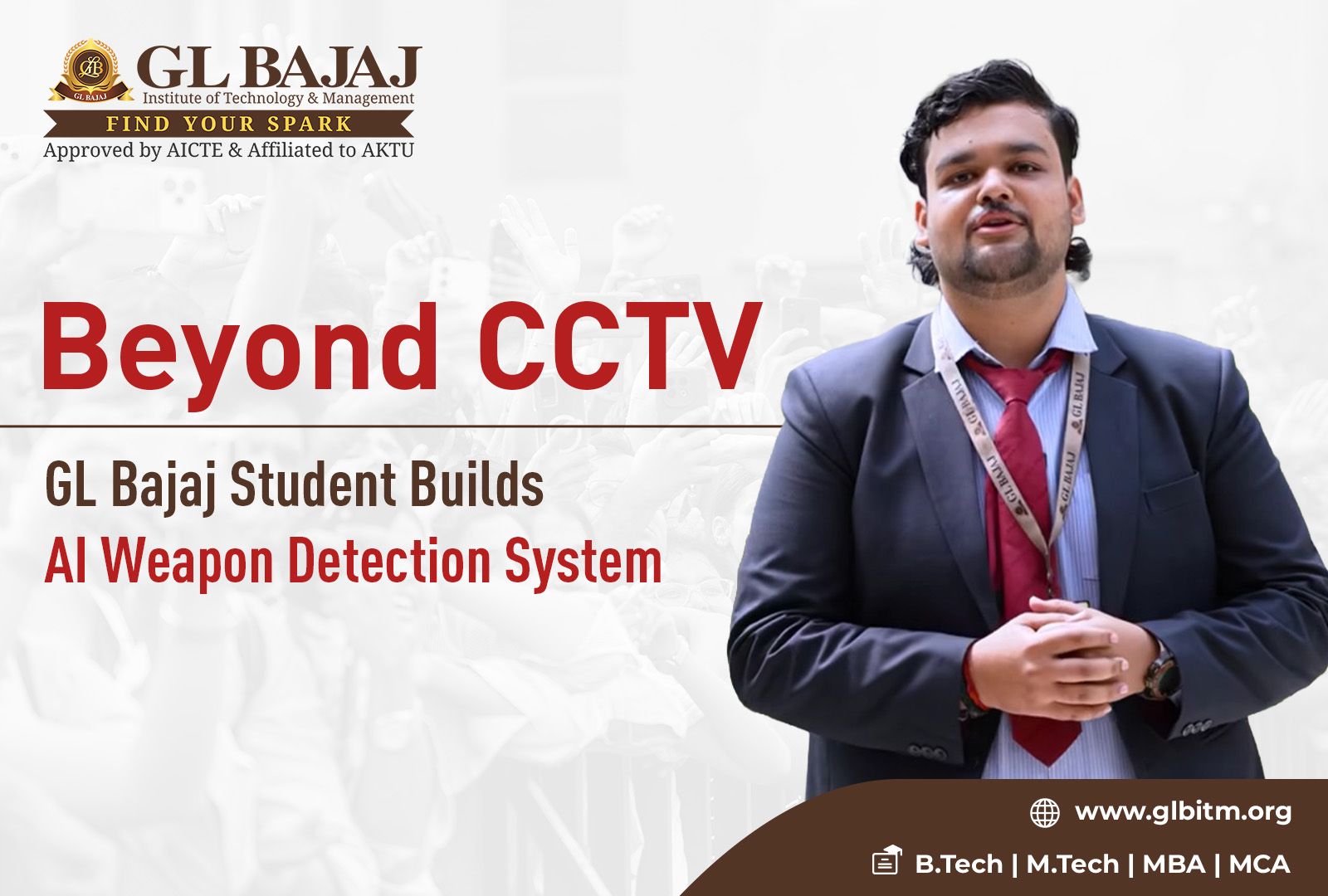
Taking this challenge as an opportunity to explore AI-driven security, Manu Tyagi, a fourth-year, sixth-semester Information Technology student at GL Bajaj Institute of Technology & Management, has developed an AI-powered Weapon Detection and Surveillance System.
The project uses artificial intelligence and computer vision to detect potential weapons through live camera feeds.
It also integrates an alert mechanism that can notify security personnel through audio alarms and SMS notifications.
By combining deep learning, video processing, and backend technologies, Manu has developed a project that connects classroom learning with a practical security challenge.
The Idea Behind the Project: Making CCTV Surveillance Smarter
Security cameras are now common in educational institutions, airports, shopping malls, offices and public spaces.
They help monitor activities and provide important visual records.
However, recording an incident and identifying it at the right moment are two different things.
Traditional surveillance systems often require security personnel to monitor multiple camera feeds.
Continuous monitoring can become difficult, especially in crowded environments where several cameras operate simultaneously.
A potential threat may go unnoticed or take time to identify.
This creates a need for smarter surveillance systems that can analyse video footage automatically and highlight situations that require attention.
This is where AI-powered weapon detection comes into the picture.
Instead of simply recording footage, an AI-based system can analyse camera frames, recognise objects and generate alerts when predefined detection conditions are met.
Understanding this possibility, Manu worked on developing a system that combines real-time weapon detection with an automated alert mechanism.
Meet Manu Tyagi: Turning an Engineering Idea into Reality
For engineering students, learning becomes more meaningful when theoretical concepts are applied to real-world challenges.
Manu Tyagi, a fourth-year Information Technology student at GL Bajaj Institute of Technology & Management, developed this project with the objective of exploring how AI can support security monitoring.
His project, AI-Powered Weapon Detection and Surveillance System, focuses on identifying potential weapons through live camera feeds and notifying security personnel when a detection condition is triggered.
Building this application involved bringing different technologies together.
From developing the AI-based detection process to integrating backend services and SMS notifications, the project combines multiple areas of computer science.
It also demonstrates how students can explore emerging technologies and use their technical knowledge to work on practical problems.
How Does the AI-Powered Weapon Detection System Work?
The interesting part of Manu’s project is how different technologies work together to create a connected detection and alert system.
The application follows this process:
Camera Feed → YOLO Model → Weapon Detection → Bounding Box + Alarm → SMS Alert with Location
Let’s understand each stage.
1. Camera Captures Live Footage
The process starts with a webcam or connected camera.
The camera continuously captures video footage and provides frames for the AI model to analyse.
2. YOLO Model Identifies Potential Weapons
The system uses YOLO (You Only Look Once), an object detection model designed for fast visual recognition.
YOLO analyses camera frames and identifies objects that match the categories it has been trained to recognise.
Its real-time processing capabilities make it suitable for applications that require quick visual analysis.
3. Detection with a 50% Confidence Threshold
When the model identifies a potential weapon, it generates a confidence score for its prediction.
In this project, a confidence threshold of 50% is configured to trigger the detection-related response.
Predictions meeting or exceeding this threshold can activate the next steps in the workflow.
However, a confidence score is not the same as detection accuracy.
The model’s actual performance must be evaluated separately using metrics such as precision, recall and mean Average Precision (mAP).
4. Bounding Boxes Highlight Detected Objects
Once a potential weapon is detected, the system displays a bounding box around the identified object.
This helps the monitoring person identify the part of the video frame that triggered the detection.
OpenCV supports the image and video processing required to display these results.
5. Audio Alarm and SMS Notifications
After the detection condition is met, the system triggers an audio alarm.
It also integrates the Twilio SMS API to send notifications to designated security personnel.
This connects the AI detection process with an alert mechanism, helping security teams receive information about potential threats.
6. Location Sharing for Faster Response
Location information can make an alert more useful.
For this purpose, the project integrates a Geolocation API to obtain location details. Google Maps can support the presentation of the location.
Together, these features connect object detection, audio alerts, SMS notifications and location information in one workflow.
The Technology Behind the Innovation
Developing an AI-powered surveillance application requires different technologies to perform specific tasks.
Manu’s project combines AI/ML frameworks, computer vision tools, backend development and web technologies.
1. YOLO: The Core Detection Model
YOLO is the primary object detection technology used in the project.
It analyses images and video frames to identify objects and generate predictions with confidence scores.
Its ability to process visual information efficiently makes it useful for real-time detection applications.
2. PyTorch: Supporting Deep Learning
PyTorch is a deep-learning framework used in the AI/ML development process.
It provides tools for working with neural networks and supports model training and inference.
3. OpenCV: Making Video Processing Possible
OpenCV is an open-source computer vision library.
It supports camera integration, image processing, and video frame handling. It also helps display detection results through bounding boxes.
4. FastAPI: Connecting the Backend
FastAPI is used to develop the backend API.
It supports communication between different application components and helps manage detection-related requests and alerts.
5. Twilio: Sending SMS Alerts
Twilio provides the SMS notification functionality.
When the configured detection condition is met, the system can send an alert to designated security personnel.
6. Geolocation API and Google Maps: Adding Location Information
The Geolocation API supports location-related functionality, while Google Maps can help present location information.
These technologies contribute to making alerts more informative.
7. Python, HTML, CSS and JavaScript: Building the Application
Python supports the AI model, backend and detection process.
HTML, CSS and JavaScript contribute to the web interface and camera integration, bringing the different components together into an accessible application.
What Makes This AI Surveillance Project Stand Out?
The project goes beyond simply identifying objects in a camera feed.
It combines detection with additional features that support a connected alert mechanism.
- Real-Time Weapon Detection: Analyses live camera feeds to identify potential weapons.
- AI-Based Object Recognition: Uses YOLO to process visual information.
- Bounding Box Detection: Highlights objects identified by the model.
- 50% Confidence Threshold: Uses a configured threshold to trigger detection-related actions.
- Audio Alarm: Generates an audible alert when the detection condition is met.
- SMS Notifications: Uses Twilio to notify designated security personnel.
- Location Sharing: Integrates location information into the alert workflow.
- Web Interface: Supports interaction with the surveillance application.
The combination of these features demonstrates how AI can connect visual recognition with automated communication.
From Code to Real-Time Detection: What Did the Project Achieve?
A technology project becomes more meaningful when its working process can be demonstrated.
Manu’s project successfully implements real-time detection functionality using camera frames and a YOLO-based model.
- Processing live camera frames.
- Identifying potential weapons through AI-based object detection.
- Displaying bounding boxes around detected objects.
- Triggering an audio alarm.
- Integrating SMS notifications.
- Supporting location information in the alert workflow.
These capabilities demonstrate the practical integration of computer vision, deep learning, and backend technologies.
However, the performance of an AI model should not be judged only by whether it produces a detection.
Its reliability also depends on how accurately it identifies objects under different conditions.
Metrics such as precision, recall, F1-score and mAP can help evaluate its performance.
Testing across different lighting conditions, camera angles and environments can provide further insights.
Where Could AI-Powered Weapon Detection Make a Difference?
The potential applications of AI-based weapon detection extend across several environments where security monitoring is important.
1. Educational Institutions
Schools, colleges, and universities have multiple entry points and shared spaces.
AI-assisted surveillance could support security teams by identifying potential threats that require attention.
2. Airports and Railway Stations
These locations experience continuous movement and large crowds.
Intelligent video analysis could provide additional support to existing surveillance arrangements.
3. Shopping Malls and Commercial Buildings
Large commercial spaces often have several surveillance cameras.
AI-based detection could help security teams prioritise camera feeds that require closer attention.
4. Public Spaces and Event Venues
Concerts, public gatherings and other crowded environments require effective security monitoring.
AI-assisted detection could support personnel in identifying situations that need verification.
These are potential application areas for the technology. Actual deployment would require further testing, validation, and appropriate security approvals.
What Makes This Project a Learning Milestone for an Engineering Student?
Developing a project that combines artificial intelligence, computer vision, and communication technologies offers valuable learning opportunities.
The project brings together several important areas of engineering:
- Artificial Intelligence: Understanding how machine learning models identify objects.
- Computer Vision: Working with images, video frames, and visual information.
- Backend Development: Connecting different application components through APIs.
- Web Development: Building an interface for camera integration and system interaction.
- API Integration: Connecting external services for notifications and location information.
- Problem-Solving: Bringing multiple technologies together to address a practical challenge.
Understanding a technology is one thing, but applying it to solve a real problem requires a different level of thinking.
From Classroom Learning to Real-World Innovation at GL Bajaj
Engineering education continues to evolve with emerging technologies and changing industry requirements.
Students today need opportunities to explore beyond theoretical concepts and understand how technology can address practical challenges.
Projects like Manu Tyagi’s AI-Powered Weapon Detection and Surveillance System reflect this connection between academic learning and practical application.
By exploring technologies such as YOLO, PyTorch, OpenCV, and FastAPI, students gain exposure to different areas of modern software development.
At GL Bajaj Institute of Technology & Management, student-led technical projects offer opportunities to explore emerging technologies, develop problem-solving skills and experiment with innovative ideas.
Such initiatives encourage students to look at engineering from a broader perspective, where the objective is not simply to develop an application but to understand the problem it is designed to address.
What’s Next? Exploring the Future of AI-Powered Surveillance
AI-based surveillance systems have significant scope for further development.
While Manu’s project establishes a working detection and alert workflow, additional improvements could make the application more reliable and suitable for broader testing.
Improved Detection Performance: Testing with larger and more diverse datasets to improve detection quality.
- Reduced False Alarms: Fine-tuning the model and detection threshold to reduce incorrect predictions.
- Better Environmental Adaptability: Evaluating performance under different lighting conditions, camera angles, and crowded environments.
- Advanced Monitoring Dashboard: Developing a central interface to manage detection events and alerts.
- Stronger Data Security: Introducing privacy controls, secure data handling and access management.
- Real-World Pilot Testing: Evaluating the system under controlled conditions with human verification.
These improvements could help explore the broader possibilities of AI-assisted security systems.
One Student Project, A Bigger Idea
Every meaningful innovation begins with a question. Sometimes, it is about how an existing process can become faster, smarter, or more effective.
Manu Tyagi’s AI Powered Weapon Detection and Surveillance System explores one such possibility: making surveillance more responsive through artificial intelligence.
By bringing together YOLO, PyTorch, OpenCV, FastAPI, and communication APIs, the project demonstrates how engineering concepts can be connected to address a real-world concern.
More importantly, it highlights the value of practical learning, where students move beyond understanding technology and begin exploring what they can build with it.
At GL Bajaj Institute of Technology & Management, projects like these reflect the spirit of student innovation and the growing role of emerging technologies in engineering education.
Because the future of engineering is not just about building smarter technology. It is about using that technology to solve problems that matter.
Frequently Asked Questions (FAQs)
1. What is an AI-powered weapon detection system?
An AI-powered weapon detection system uses computer vision and deep learning to identify potential weapons in video footage.
2. How does YOLO detect weapons in real-time video?
YOLO analyses video frames, identifies potential weapons, and displays bounding boxes with confidence scores.
3. Which technologies are used in Manu Tyagi’s weapon detection project?
The project uses YOLO, PyTorch, OpenCV, FastAPI, Python, JavaScript, Twilio and Geolocation API.
4. How does the system send security alerts?
The system triggers an audio alarm and Twilio SMS when weapon detection confidence exceeds 50%.
5. What is the role of OpenCV in AI-based surveillance?
OpenCV handles video processing, camera integration, frame analysis and displays detected objects with bounding boxes.
6. Can AI-powered weapon detection systems improve security monitoring?
Yes, they help security teams identify potential threats faster while supporting human verification and security procedures.
7. Where can AI-based weapon detection systems be used?
These systems can support monitoring across educational institutions, airports, railway stations, malls and public venues.
8. How do engineering students develop real-world AI projects at GL Bajaj?
GL Bajaj students apply AI, machine learning and computer vision to develop practical, real-world technology solutions.
