Engineering research is entering an era in which the most important breakthroughs will emerge not from a single discipline but from collaboration among multiple fields. Interdisciplinary innovation combines engineering with artificial intelligence, data science, robotics, electronics, healthcare, environmental science, management and other domains to solve complex real-world problems.
The future of engineering research will therefore depend on professionals who can connect ideas across disciplines, use emerging technologies responsibly and convert research into practical solutions.
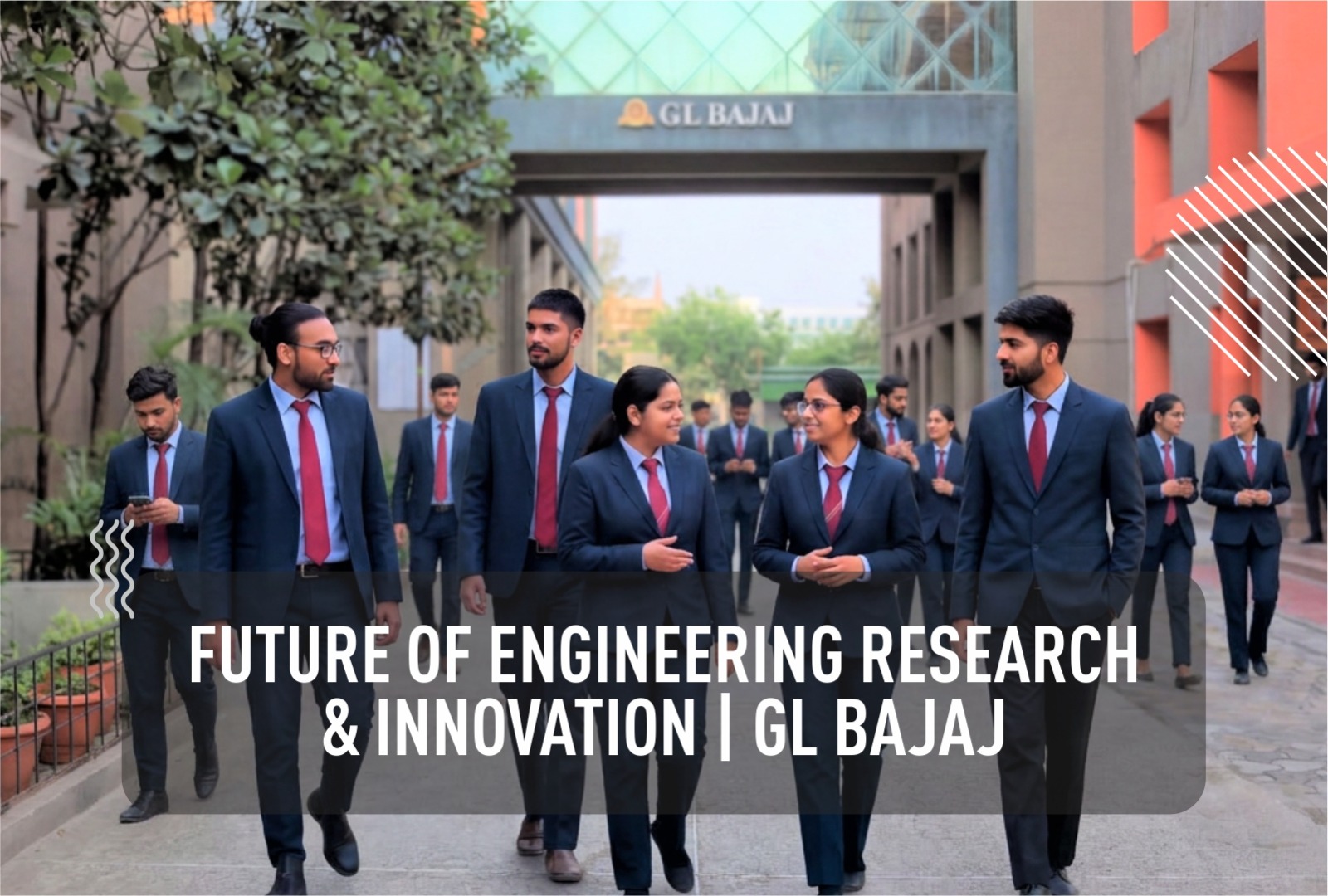
At GL Bajaj Institute of Technology and Management, this approach is reflected in an academic and research ecosystem that encourages technical learning, experimentation, industry interaction and innovation.
What Is Interdisciplinary Innovation in Engineering?
Interdisciplinary innovation is the process of combining knowledge, methods and technologies from different fields to create improved products, systems or services. Instead of examining a problem from only one technical perspective, researchers collaborate across subject areas.
For example, developing an autonomous electric vehicle may require mechanical engineering for vehicle design, electronics for sensors, computer science for intelligent navigation, data science for performance analysis and management expertise for commercial viability.
This collaborative approach helps researchers understand a problem more completely. It also leads to solutions that are practical, scalable and better aligned with human needs.
Why Is Interdisciplinary Research the Future of Engineering?
Modern challenges are too interconnected to be solved by one engineering branch alone. Climate change, smart cities, cybersecurity, renewable energy, healthcare accessibility and sustainable manufacturing involve technological, environmental, economic and social considerations.
Interdisciplinary engineering research offers several important benefits:
- It brings together different perspectives and problem-solving methods.
- It accelerates the development of innovative technologies.
- It improves the real-world relevance of research.
- It encourages collaboration between academia and industry.
- It prepares students for technology-driven careers.
- It supports the creation of sustainable and user-focused solutions.
As industries become more digitally connected, employers will increasingly value engineers who understand their core discipline while also communicating and collaborating across technical boundaries.
Artificial Intelligence as a Research Enabler
Artificial intelligence is becoming an essential component of engineering research. Researchers can use AI and machine learning to analyse large datasets, simulate complex systems, identify patterns and optimise designs.
Mechanical engineers can use predictive models to anticipate equipment failures. Electronics engineers can integrate intelligent sensors into connected devices.
Civil and environmental researchers can use data to improve energy and resource management. Computer science researchers can develop safer, more transparent and efficient algorithms.
AI does not replace engineering knowledge. Instead, it strengthens the researcher’s ability to test ideas, make evidence-based decisions and solve problems more efficiently.
Robotics, Automation and Smart Manufacturing
Robotics and automation demonstrate how multiple engineering disciplines can work together. A modern robotic system may include mechanical components, electronic circuits, embedded software, computer vision, artificial intelligence and cloud connectivity.
Future research in this area will focus on collaborative robots, autonomous machines, intelligent production lines and safer human-machine interaction.
Smart manufacturing will also depend on the Internet of Things, digital twins and predictive maintenance.
Through such research, engineers can improve productivity, reduce waste and design manufacturing systems that respond quickly to changing market requirements.
Sustainable Engineering and Clean Technology
Sustainability will remain one of the most important priorities in engineering research. Researchers must create technologies that meet present needs without placing unnecessary pressure on future resources.
Interdisciplinary teams can contribute to renewable energy systems, electric mobility, green buildings, waste management, water conservation and energy-efficient computing.
For example, developing a smart energy grid requires expertise in electrical systems, communication networks, data analytics, cybersecurity and public policy.
The next generation of engineers will need to consider environmental impact throughout the complete lifecycle of a product—from material selection and manufacturing to operation, reuse and recycling.
Healthcare Engineering and Human-Centred Innovation
The interaction between engineering and healthcare is creating new possibilities in medical devices, wearable sensors, assistive technologies, robotic surgery and AI-supported diagnostics.
Successful healthcare innovation requires collaboration among engineers, medical professionals, data scientists and designers. Researchers must also consider privacy, safety, accessibility and ethics.
Human-centred engineering ensures that a technically advanced solution is also easy to use, affordable and suitable for the people it is designed to serve.
This focus will become increasingly important as technology becomes more closely integrated into daily life.
The Importance of Industry–Academia Collaboration
Engineering research creates greater value when academic knowledge is connected with industry experience. Companies can provide researchers with practical problems, technical insights and real operating environments.
Educational institutions contribute scientific methods, creative thinking and skilled research teams.
Industry–academia collaboration can support internships, sponsored projects, specialised training, joint research and technology transfer. It also enables students to understand professional standards and emerging market needs.
This relationship shortens the distance between an idea developed in a laboratory and a solution successfully implemented in society.
Building an Interdisciplinary Research Culture at GL Bajaj
GL Bajaj Institute of Technology and Management provides a relevant environment for interdisciplinary engineering learning. The institute offers B.Tech programmes across areas including Computer Science and Engineering, Artificial Intelligence, AI and Machine Learning, Data Science, Electrical and Computer Science, Electronics and Communication Engineering and Mechanical Engineering. The presence of these complementary disciplines creates opportunities for students to exchange ideas and approach projects from multiple perspectives.
The institute’s official website also lists a dedicated Research and Development ecosystem, student projects, research projects, publications, conferences, an IPR Cell and an Institute Innovation Cell. Its Centres of Excellence include the NVIDIA AI Learning and Research Center, AICTE IDEA Lab, AR/VR Centre of Excellence, Advance Robotics Lab, CISCO Centre of Excellence and Innovation and Incubation Cell.
These facilities can help students move from classroom concepts to experimentation, prototyping and applied innovation. Explore GL Bajaj’s academic and research ecosystem.
By participating in collaborative projects, workshops, research activities and industry-oriented learning, GL Bajaj students can strengthen both technical depth and interdisciplinary thinking.
Such exposure is valuable for careers in research, product development, entrepreneurship and emerging technology.
Skills Future Engineering Researchers Will Need
Technical expertise will continue to be essential, but future researchers will require a wider set of capabilities. Important skills will include:
- Strong fundamentals in a primary engineering discipline
- Data analysis and computational thinking
- Knowledge of AI, automation and digital tools
- Research methodology and technical writing
- Design thinking and rapid prototyping
- Communication and teamwork
- Awareness of ethics, safety and sustainability
- Intellectual property and entrepreneurship knowledge
Students who develop this combination will be better prepared to contribute to multidisciplinary teams and turn research outcomes into meaningful solutions.
From Research Ideas to Real-World Impact
The success of engineering research should not be measured only by publications or prototypes. Its true value lies in improving industries, communities and everyday life.
Innovation and incubation support can help researchers evaluate market needs, protect intellectual property, develop prototypes and explore entrepreneurship. Feedback from users and industry experts can further improve a solution before large-scale implementation.
At GL Bajaj, the connection among technical departments, research initiatives, Centres of Excellence and incubation activities can encourage students to view engineering research as a complete journey—from identifying a problem to creating measurable impact.
Conclusion
The future of engineering research is interdisciplinary, collaborative and purpose-driven. Technologies such as AI, robotics, data science, smart electronics and sustainable systems will increasingly overlap, making cross-disciplinary knowledge essential.
Engineering institutions must therefore encourage students to explore beyond traditional academic boundaries. With its diverse engineering programmes, research initiatives, specialised Centres of Excellence and innovation ecosystem, GL Bajaj Institute of Technology and Management offers students opportunities to develop this broader outlook.
Future engineers will not simply build machines or write software. They will connect technologies, understand human needs and create responsible solutions for a rapidly changing world.
Frequently Asked Questions
1. What is interdisciplinary engineering research?
Interdisciplinary engineering research combines knowledge and methods from two or more fields to solve complex problems. It may connect mechanical engineering, electronics, computer science, AI, data science, management or other disciplines.
2. Why is interdisciplinary innovation important for engineering students?
It helps students develop wider problem-solving abilities, collaborate with diverse teams and understand how different technologies work together. These skills are valuable for research, employment and entrepreneurship.
3. Which technologies will shape the future of engineering research?
Artificial intelligence, robotics, the Internet of Things, digital twins, renewable energy, advanced materials, cybersecurity, AR/VR and intelligent automation are expected to influence future research significantly.
4. How does GL Bajaj support engineering research and innovation?
GL Bajaj supports research through its R&D ecosystem, student and research projects, IPR and Innovation Cells, industry–academia initiatives and specialised Centres of Excellence in areas such as AI, robotics, AR/VR and networking.
5. What skills should a future engineering researcher develop?
Students should build strong technical fundamentals along with data analysis, research methodology, communication, teamwork, design thinking, ethical awareness and prototyping skills.
6. Can interdisciplinary research improve career opportunities?
Yes. It prepares graduates for roles that require knowledge across multiple technologies, including AI engineering, automation, product development, sustainable technology, research and innovation consulting.
