Farming is more than an occupation in India; it supports millions of families and plays a vital role in food security.
However, unpredictable weather, crop diseases, uncertain yields, and fluctuating market prices continue to challenge farmers.
What if technology could help farmers make better decisions?
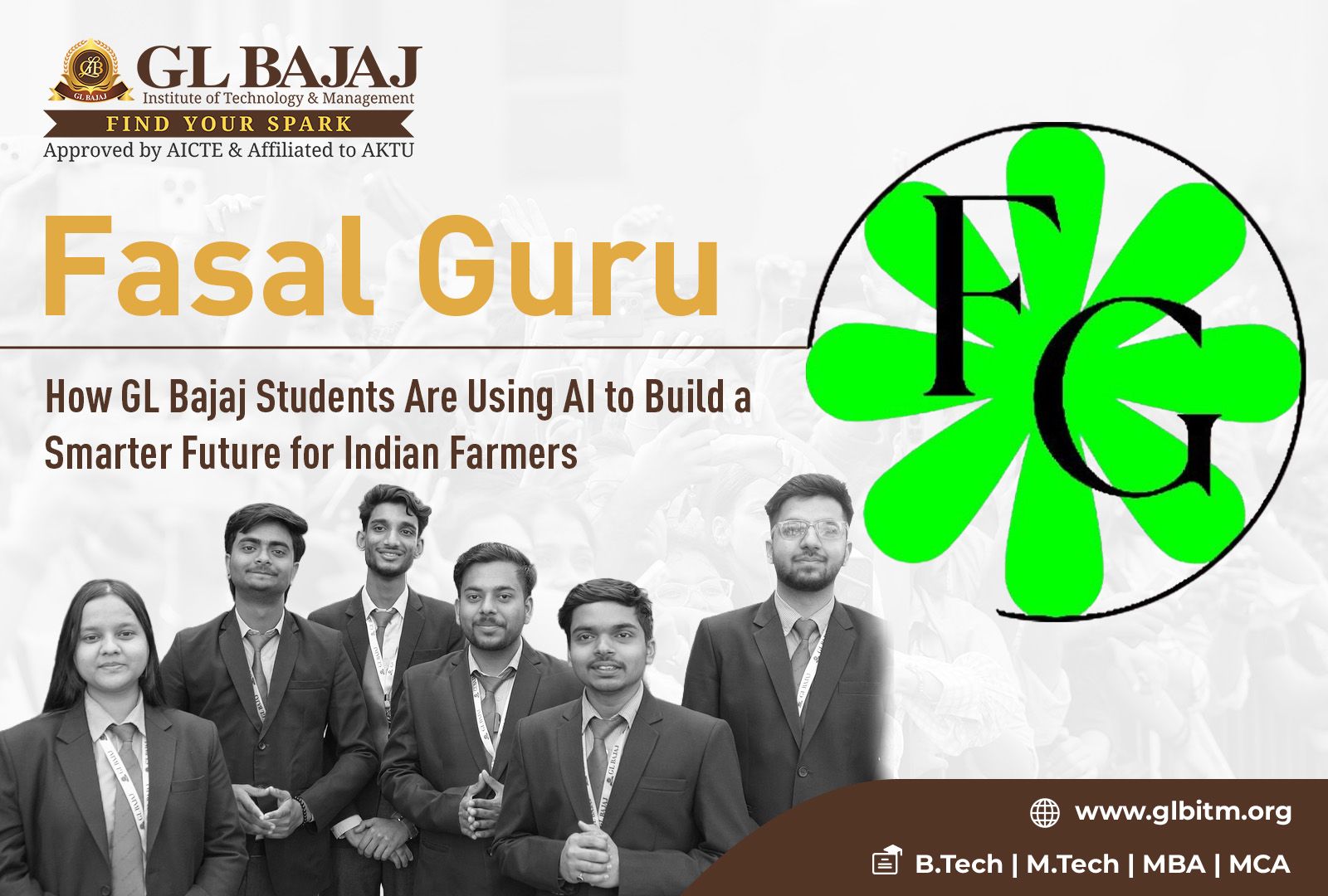
Addressing this challenge, FASALGuru, developed by student innovators at GL Bajaj Institute of Technology & Management, Greater Noida, uses AI, satellite imagery, and weather forecasting to support smarter farming.
Led by Luv Agnihotri, the project secured Rank 1 among 450+ teams in the SIH 2025 internal round and became a grand finalist.
Understanding the Problem: Why Farmers Need Better Information
Farmers make several important decisions throughout a crop cycle.
They must determine when to sow seeds, how to manage soil nutrients, when to irrigate, how to respond to crop diseases, and when to prepare for harvesting.
These decisions become more difficult when reliable information is unavailable or arrives too late.
Three major challenges highlight the need for smarter agricultural solutions.
1. Uncertain Weather and Changing Climate Conditions
Unpredictable rainfall, rising temperatures, and changing seasonal patterns can affect crop growth and productivity.
Without accessible and timely weather information, farmers may struggle to plan irrigation, sowing, or harvesting activities.
2. Limited Visibility into Crop and Soil Health
Crop damage is not always immediately visible.
Changes in plant health, soil conditions, or moisture levels can affect productivity before farmers recognise the problem.
Regular field inspection is useful, but monitoring large agricultural areas can require considerable time and effort.
3. Yield Uncertainty and Complicated Insurance Processes
Estimating the expected harvest helps farmers plan storage, transportation, and sales. However, uncertain yields can make these decisions difficult.
Insurance claims can also involve documentation, verification, and assessment of crop losses. Simplifying access to relevant agricultural data could help make these processes more efficient.
FASALGuru aims to address these challenges by connecting agricultural data with practical decision-support tools.
What Is FASALGuru?
FASALGuru stands for Farm Advisory System for Agricultural Land.
It is an AI-powered digital agriculture platform designed to help farmers access useful information about their crops and farming conditions.
Rather than requiring farmers to interpret multiple sources of technical information themselves, the platform brings together different agricultural technologies through a connected system.
Its key objectives include:
- Monitoring crop health using satellite-based analysis.
- Estimating potential crop yields using agricultural simulation models.
- Supporting AI-based crop disease detection.
- Analysing soil-related information.
- Providing multilingual weather forecasts.
- Supporting agricultural market information through an e-mandi feature.
- Simplifying the agricultural insurance-claim workflow.
- Improving accessibility through KISAN GURU, an AI-based assistant.
The central idea behind FASALGuru is to make agricultural technology more useful and accessible to the people who need it.
How FASALGuru Uses AI and Satellite Technology
One of the defining aspects of FASALGuru is its integration of multiple technologies into a single agricultural decision-support platform.
1. Satellite-Based Crop Health Monitoring
FASALGuru uses satellite imagery accessed through the Sentinel Hub API.
The platform is designed to analyse crop conditions using the Normalized Difference Vegetation Index, commonly known as NDVI.
NDVI uses the difference between vegetation’s reflection of near-infrared and red light to help assess vegetation conditions.
This analysis can provide useful indicators of crop growth and variations in vegetation health across agricultural land.
Farmers and agricultural advisers can use such information to identify areas that may require closer inspection.
Satellite-based monitoring can be particularly useful when a farm covers a large area or when repeated field-level observations are difficult.
However, NDVI is an indicator rather than a definitive diagnosis. Additional field observations and other data may be needed to determine the actual cause of crop stress.
2. Crop Yield Estimation Using DSSAT
Estimating crop yield before harvesting can support better agricultural planning.
FASALGuru integrates the Decision Support System for Agrotechnology Transfer, or DSSAT, a crop-growth simulation modelling system used to study crop development under different environmental and management conditions.
By integrating crop simulation capabilities into its platform, FASALGuru aims to support yield estimation using relevant crop, weather, soil, and agricultural management information.
Such estimates can help farmers understand possible harvest outcomes and prepare for decisions related to storage, transportation, and market planning.
Actual results depend on the quality of the input data, crop conditions, and model calibration.
Yield estimates should therefore be treated as informed projections rather than guaranteed outcomes.
3. AI-Based Crop Disease Detection
Crop diseases can affect productivity and increase cultivation costs, particularly when symptoms are identified late.
FASALGuru incorporates an AI-based disease detection component intended to help identify potential crop health problems. Such a system can support early investigation and help farmers decide when further assessment or agricultural advice may be necessary.
When connected with other crop-monitoring information, disease detection can contribute to a broader understanding of field conditions.
Accurate identification remains important, as different diseases and environmental stresses can sometimes produce similar symptoms.
4. AI-Based Soil Analysis
Healthy soil is essential for sustainable farming.
Soil properties influence nutrient availability, water retention, root development, and overall crop performance.
FASALGuru includes an AI-based soil analysis component designed to support agricultural assessment. By incorporating soil-related information into the decision-making process, the platform aims to help farmers better understand the conditions affecting their crops.
Reliable recommendations depend on the availability and quality of soil data, including laboratory measurements or appropriate field observations where required.
5. Multilingual Weather Forecasting
Weather information becomes more useful when farmers can understand it easily and apply it to their daily work.
FASALGuru incorporates multilingual weather forecasting to make weather-related information more accessible to users who may prefer communicating in regional languages.
Timely forecasts can support planning for irrigation, sowing, spraying, and harvesting.
They can also help farmers prepare for potentially disruptive weather conditions.
The platform’s focus on language accessibility recognises that agricultural technology must be designed around its users, rather than expecting every user to adapt to complex digital systems.
KISAN GURU: Making Agricultural Technology More Accessible
Technology can be powerful, but its usefulness depends on how easily people can interact with it.
For farmers who are unfamiliar with complex digital interfaces, navigating multiple screens or interpreting technical reports can create an additional challenge.
FASALGuru addresses this concern through KISAN GURU, an AI-based bot designed to improve accessibility.
The assistant aims to make interaction with the platform more convenient and approachable.
Its voice-based and language-oriented approach aligns with the project’s broader objective of reducing the communication barriers associated with digital agriculture.
A farmer-focused digital assistant can help users access information without requiring them to understand the technical systems working behind the platform.
By prioritising accessibility alongside functionality, FASALGuru demonstrates an important principle of technology development: innovation should not only solve a problem but also make the solution practical for its intended users.
E-Mandi: Connecting Farm Decisions with Market Information
Growing a healthy crop is only one part of the agricultural journey. Farmers must also make decisions about when and where to sell their produce.
Market prices can change depending on supply, demand, quality, location, and other factors.
Limited access to timely market information can make sales planning more difficult.
FASALGuru includes an e-mandi feature intended to bring market-related information into the broader farming support system.
When used alongside yield estimates, this type of feature can help farmers consider potential harvest quantities and market conditions while planning their next steps.
The availability of reliable, location-specific, and regularly updated market data is essential for making such information useful.
The feature’s value ultimately depends on the accuracy and freshness of the information provided.
Simplifying Agricultural Insurance Through Data Integration
Crop losses can create financial uncertainty for farming households.
Agricultural insurance programmes are intended to provide support when eligible losses occur, but the claim process can involve several stages of assessment and documentation.
FASALGuru aims to simplify this workflow by connecting satellite analytics, crop-related information, and AI-based disease detection with an agricultural insurance-claim pipeline.
The intended process brings together information that may support crop assessment and claim preparation.
Structured digital workflows can reduce repetitive manual tasks and make it easier to organise relevant information.
The platform is designed with end-to-end PMFBY insurance-claim processing in mind, linking agricultural analytics with the claim workflow.
However, satellite analysis or AI predictions alone do not establish insurance eligibility or guarantee claim approval.
Official requirements, supporting evidence, insurer verification, and applicable Pradhan Mantri Fasal Bima Yojana (PMFBY) procedures remain important.
By exploring how agricultural data can support insurance-related processes, FASALGuru extends its focus beyond crop monitoring to another important aspect of farmers’ needs.
The Technology Stack Behind FASALGuru
Developing an integrated agricultural platform requires a technical foundation that can connect different services and process information efficiently.
The FASALGuru team uses a combination of programming languages, frameworks, databases, and external agricultural data services.
| Technology | Role in the Project |
| Python | Backend development and data processing |
| FastAPI | Building backend services and RESTful APIs |
| React.js | Developing the user interface |
| PostgreSQL | Storing and managing structured data |
| Sentinel Hub API | Accessing satellite imagery |
| DSSAT | Integrating crop-growth simulation capabilities |
The platform’s RESTful API architecture is designed to connect satellite-based crop data, crop simulation models, and backend services.
This modular approach helps organise different functions within a unified system.
It also provides a foundation for extending the platform as additional agricultural data sources and features become available.
The project’s technical direction reflects the application of computer science concepts to a real-world challenge, bringing together software development, AI, data analysis, and agricultural technology.
Meet the Student Team Behind FASALGuru
FASALGuru is a collaborative project built by students from different academic programmes at GL Bajaj Institute of Technology & Management.
Each member contributes to the broader effort to develop a technology-driven agricultural solution.
Programme: Computer Science and Engineering (Artificial Intelligence)
Programme: Computer Science and Engineering (Artificial Intelligence)
Programme: Computer Science and Engineering (Artificial Intelligence)
Programme: Computer Science and Engineering (Artificial Intelligence)
Programme: Computer Science and Engineering
Programme: Information Technology
The team’s interdisciplinary collaboration highlights how students can bring together their technical knowledge, problem-solving abilities, and shared interests to work on challenges that extend beyond academic assignments.
FASALGuru’s Achievements: From Campus Innovation to National Recognition
A promising idea gains momentum when it is tested, presented, and recognised through innovation platforms.
FASALGuru has earned several notable achievements that reflect the team’s participation in competitive innovation initiatives.
The project secured Rank 1 in its Smart India Hackathon 2025 internal round, competing among more than 450 teams.
This achievement represents an important milestone in the team’s innovation journey.
SIH 2025 Grand Finalist
FASALGuru also reached the Grand Finale of the Smart India Hackathon 2025, placing the project among teams that progressed through the competition’s selection process.
MIH Hackathon Winner
The team won the MIH Hackathon, adding another achievement to its record of participation in innovation-focused competitions.
Ideathon First Runner-Up
FASALGuru also secured the first runner-up position in an ideathon, demonstrating the team’s continued engagement with idea development and technology-driven problem-solving.
Together, these achievements illustrate the importance of providing students with opportunities to develop ideas, collaborate with peers, and present technology-based solutions to practical problems.
Role of GL Bajaj in Student Innovation
Engineering education goes beyond programming languages and technical concepts; it encourages students to solve real-world problems through innovation.
FASALGuru demonstrates how students can apply their academic knowledge to address agricultural challenges using AI, machine learning, satellite data, crop simulation, and software development.
The project also highlights the importance of teamwork, interdisciplinary collaboration, and understanding users’ needs.
At GL Bajaj initiatives like FASALGuru reflect how students can transform classroom learning into technology-driven solutions with meaningful societal impact.
The Future of AI in Agriculture
Digital agriculture is creating new opportunities for farmers to make informed decisions.
Technologies such as satellite imagery, machine learning, crop simulation, and weather forecasting can improve access to agricultural information.
Platforms like FASALGuru aim to bring these tools together in one farmer-focused system.
Their success will depend on reliable data, field validation, affordability, local-language support, and ease of use.
With effective implementation, such solutions could help farmers identify potential crop problems earlier, plan farming activities confidently, and make technology more accessible to rural communities.
Building Technology with a Purpose
FASALGuru brings together AI and digital technology to address agricultural challenges through satellite-based crop monitoring, yield estimation, disease detection, soil analysis, weather forecasting, e-mandi, and the KISAN GURU assistant.
Its achievements in SIH 2025, the MIH Hackathon, and an ideathon reflect the team’s commitment to innovation.
Developed by students of GL Bajaj Institute of Technology & Management, the project highlights how engineering knowledge can create meaningful solutions.
How FASALGuru is contributing to the future of smart farming and student-led innovation.
Frequently Asked Questions
1. What is FASALGuru?
FASALGuru is an AI-powered agricultural platform combining crop monitoring, yield estimation, weather forecasts, and digital farming assistance.
2. Who developed FASALGuru?
FASALGuru was developed by students of GL Bajaj Institute of Technology & Management, Greater Noida.
3. How does FASALGuru use artificial intelligence?
It uses AI for crop disease detection, soil analysis, yield estimation, and accessible agricultural assistance.
4. What is the role of satellite imagery in FASALGuru?
Satellite imagery supports NDVI-based crop monitoring, helping identify vegetation health variations that may require further inspection.
5. How does FASALGuru support crop-yield estimation?
FASALGuru integrates DSSAT crop-growth simulation to estimate potential yields using relevant agricultural and environmental data.
6. What is KISAN GURU?
KISAN GURU is an AI-based assistant designed to make agricultural information more accessible to farmers.
7. What awards has the FASALGuru team received?
The team achieved SIH 2025 internal Rank 1, SIH Grand Finalist status, MIH Hackathon victory, and ideathon first runner-up.
8. Why is AI in agriculture important?
AI helps analyse agricultural data, monitor crops, estimate yields, and support informed farming decisions.
9. How does FASALGuru relate to engineering education at GL Bajaj?
FASALGuru demonstrates how students apply engineering knowledge, AI, and collaboration to address real-world agricultural challenges.
10. Can FASALGuru guarantee crop yields or insurance claim approval?
No. Yield estimates are projections, and insurance approvals depend on verification and applicable policy requirements.
