Getting ready for an interview involves more than memorising frequently asked questions.
Students may know the right answers but still struggle with communication, answer structure, speaking pace, or filler words.
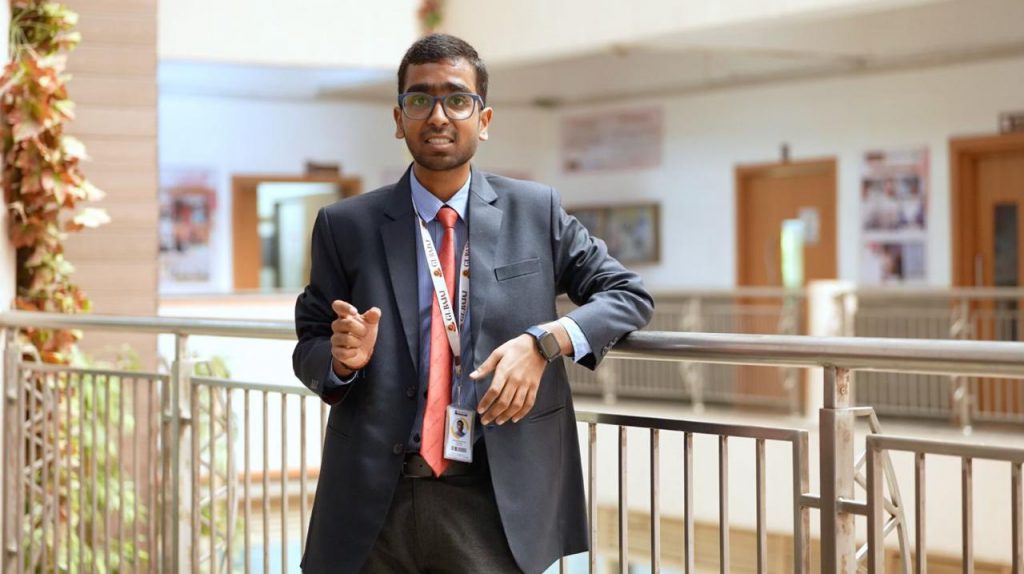
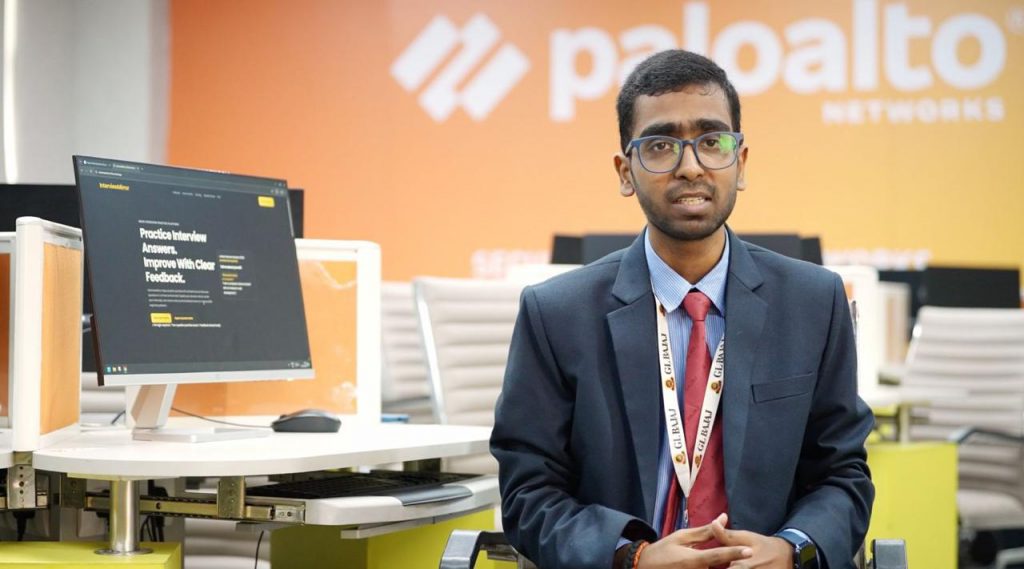
Addressing this practical gap, InterviewMirror was developed by Shantanu Katiyar, a B.Tech student at G.L. Bajaj Institute of Technology and Management.
The platform creates a simulated HR and behavioural interview environment and provides structured feedback on key aspects of performance.
It helps students identify specific areas for improvement and practise more effectively for their professional journey.
Why Interview Preparation Needs More Than Question Practice
Students often spend significant time preparing technical concepts, HR questions and common interview topics.
However, practising questions alone may not show how effectively they communicate their answers.
Candidates may give incomplete responses, stray from the question, organise their answers poorly, speak too quickly or too slowly, use excessive filler words, or miss key elements in behavioural responses.
In conventional practice sessions, identifying these issues can be difficult without structured feedback.
InterviewMirror addresses this gap through a simulated interview environment where students can practise and receive feedback based on predefined evaluation parameters.
Shantanu Katiyar’s Experience Behind InterviewMirror
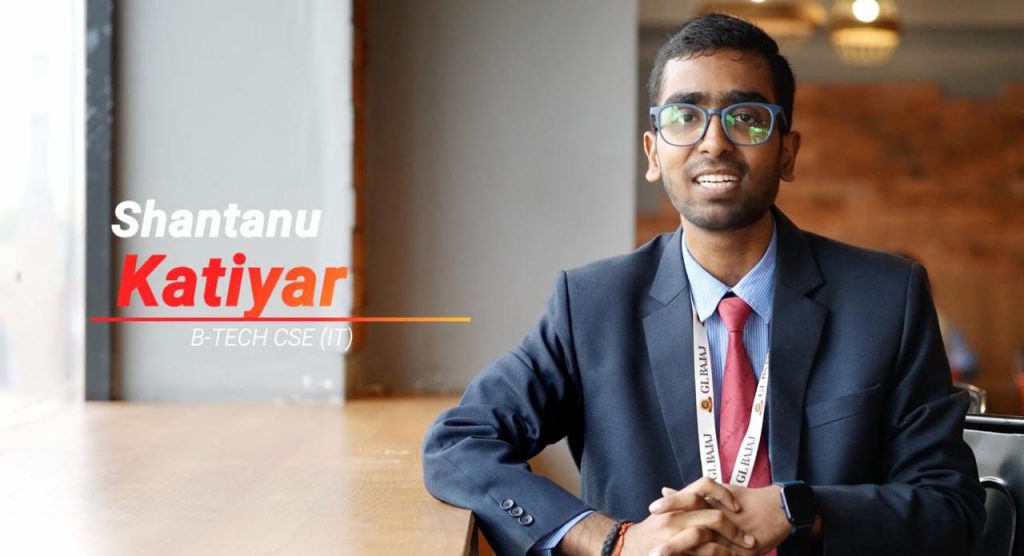
The idea behind InterviewMirror focuses on a practical aspect of student career preparation: understanding what happens after a candidate gives an interview answer.
While developing the platform, Shantanu worked on creating an environment where a student could answer interview questions using a microphone and webcam and then receive structured information about the response.
The development involved working with speech-to-text functionality, transcript processing, rule-based evaluation, and performance tracking.
The project also required integrating the frontend with a Node.js and Express.js backend and storing interview records through MySQL.
The experience provided an opportunity to apply classroom knowledge to a practical problem related to student career readiness.
Rather than building a project only for demonstration, InterviewMirror was designed around a real situation students regularly encounter: how to practise an interview and understand where improvement is needed.
What Is InterviewMirror?
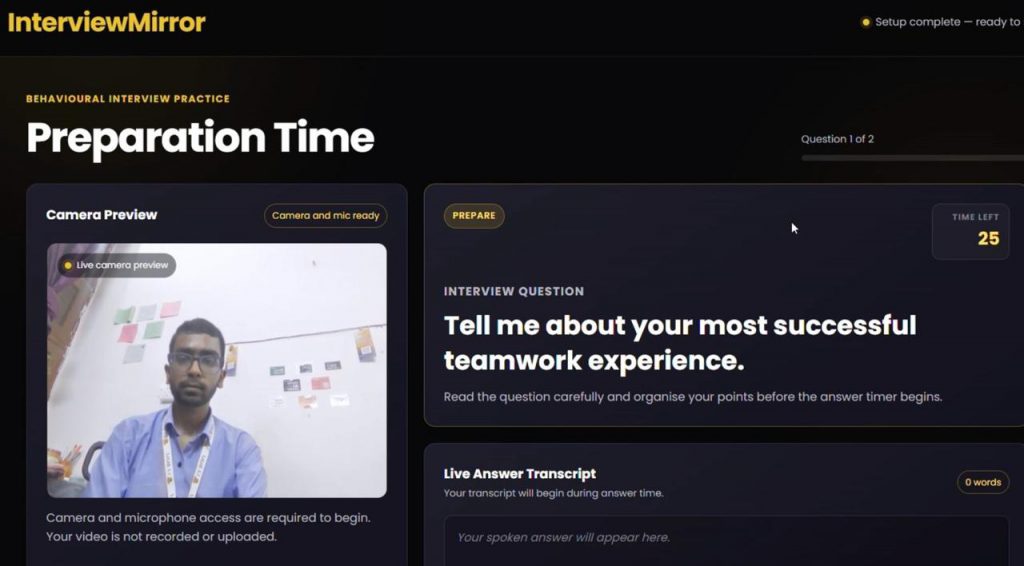
InterviewMirror does not have a separate full form. Its name represents the purpose of the platform.
Like a mirror reflects an image, InterviewMirror is designed to reflect different aspects of a candidate’s interview performance through structured feedback.
The current platform can be described as an automated interview-readiness assessment and practice tool.
It allows candidates to practise HR and behavioural interviews and receive feedback on answer completeness, relevance signals, answer structure, speaking pace and filler-word control.
Importantly, the current version is not a statistically validated predictor of whether a candidate will be selected in an actual interview.
How InterviewMirror Works
InterviewMirror follows a straightforward process that takes a student from interview selection to performance review.
From Interview Selection to Performance Report
Candidates first select an HR or behavioural interview and then respond to the displayed question using their microphone and webcam.
The Web Speech API converts the spoken response into text, after which the platform applies predefined rule based evaluation logic.
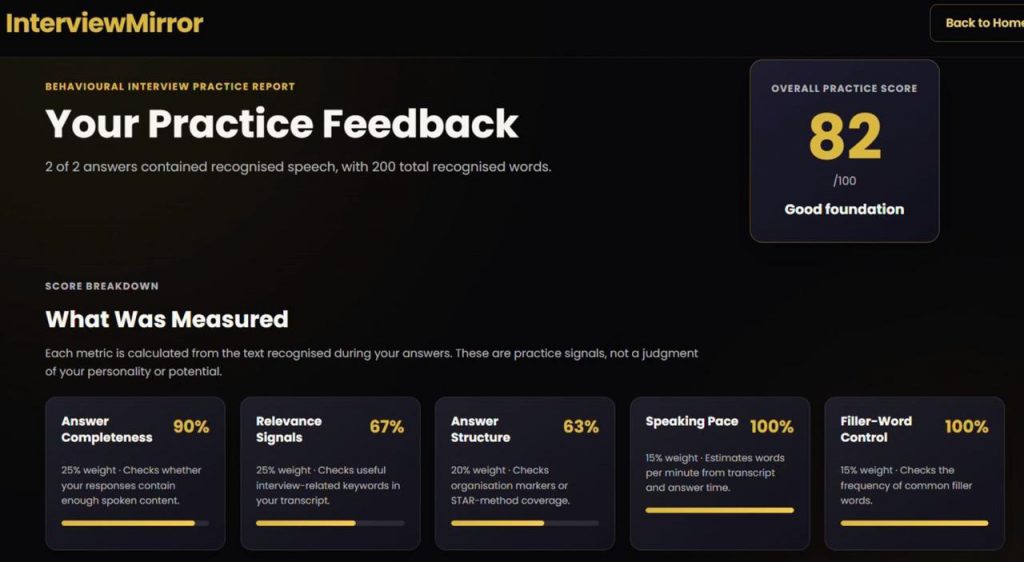
The system evaluates five performance parameters and generates an overall score, parameter-wise feedback, identified filler words, and areas for improvement.
The dashboard also stores previous interview attempts for later review.
The process can be summarised as:
Select Interview → Answer Question → Speech-to-Text → Automated Analysis → Performance Report → Review History
Five Parameters Used to Evaluate Interview Performance
InterviewMirror uses a weighted scoring system to assess multiple aspects of an interview response.
| Evaluation Parameter | Weight |
| Answer Completeness | 25% |
| Relevance Signals | 25% |
| Answer Structure | 20% |
| Speaking Pace | 15% |
| Filler-Word Control | 15% |
Answer Completeness evaluates whether the response provides sufficient information to address the question.
Relevance Signals identify predefined words or signals associated with the expected response.
Answer Structure considers how logically the response is organised.
Speaking Pace evaluates the rate at which the candidate delivers the response.
Filler-Word Control identifies unnecessary filler words that may affect communication clarity.
The weighted approach allows students to look beyond one overall number and understand the specific areas where they may need more practice.
Using the STAR Framework for Behavioural Interviews
Behavioural interviews often ask candidates to describe how they handled a particular situation or challenge.
Simply giving a general answer may make it difficult for an interviewer to understand the candidate’s actual contribution.
InterviewMirror incorporates the STAR framework for behavioural responses:
- Situation: What was happening?
- Task: What responsibility or objective did the candidate have?
- Action: What did the candidate actually do?
- Result: What was the outcome?
Using this framework can help students practise presenting experiences in a more organised format.
For example, instead of saying, “I worked on a difficult project and solved the problem,” a structured response can explain the situation, the specific responsibility, the action taken and the resulting outcome.
Technology Behind InterviewMirror
The project combines commonly used web technologies to create its interview practice environment.
| Component | Technology |
| Frontend | HTML, CSS, JavaScript |
| Backend | Node.js, Express.js |
| Database | MySQL |
| Speech Recognition | Web Speech API |
| Interview Interaction | Webcam and Microphone |
The Web Speech API plays an important role in the current version by converting spoken responses into text.
The resulting transcript and speaking information are then processed using the project’s predefined evaluation rules.
This technology stack demonstrates how web development, speech technology and database management can be combined to create a practical student-focused application.
Is InterviewMirror an AI or Machine Learning Project?
The current version of InterviewMirror does not use a separately trained Machine Learning model.
This distinction is important when describing the project.
At present, the platform uses:
Web Speech API + Speech Transcription + Rule-Based Analysis
The intelligent analysis evaluates predefined indicators such as answer completeness, relevance signals, structure, speaking pace, filler words and STAR-related elements.
There is significant scope for introducing more advanced AI technologies in future versions.
Potential developments include Natural Language Processing, Machine Learning, semantic understanding, context-aware feedback, personalised recommendations and sentiment or emotion analysis.
Therefore, the current platform should accurately be described as an automated interview-readiness assessment tool, rather than a machine-learning-based interview-selection predictor.
Features That Make InterviewMirror Useful for Students
InterviewMirror brings several interview preparation functions together in one platform.
- Interactive mock interview environment
- HR interview practice
- Behavioural interview practice
- Real-time speech-to-text transcription
- Webcam-based interview interaction
- Automated response evaluation
- Five-parameter performance scoring
- Answer completeness analysis
- Relevance signal detection
- STAR-based behavioural response analysis
- Speaking pace evaluation
- Filler-word identification
- Detailed interview performance report
- PDF performance report
- Personalised dashboard
- Interview history
- Performance tracking
- Interview question bank
- Parameter-wise feedback
- Identification of areas requiring improvement
Together, these features provide students with a structured way to practise rather than relying only on memorisation.
From Practice to Progress: The Role of Interview History
One of the useful elements of InterviewMirror is its dashboard and interview history.
A student can complete multiple practice sessions and review previous attempts. This creates a simple cycle:
Practice → Review → Identify Weakness → Practise Again → Compare Performance
For example, a student may discover that their answers are reasonably complete but that they use too many filler words.
After several practice attempts, they can review their previous records and focus specifically on communication improvement.
The platform therefore supports repeated practice and self-evaluation rather than treating a mock interview as a one-time activity.
How InterviewMirror Supports Career Readiness
Career readiness involves more than academic knowledge. Students also need to communicate their knowledge and experiences effectively during recruitment processes.
A best placement engineering college can provide students with opportunities for recruitment and professional exposure, but students also need to develop the skills required to make effective use of those opportunities.
InterviewMirror focuses on some of these practical skills, including:
- Communication
- Structured thinking
- Response clarity
- Self-evaluation
- Behavioural interview preparation
- Consistent practice
- Awareness of communication habits
The platform can therefore complement conventional interview preparation by giving students an additional method of reviewing their performance.
B.Tech CSE Admission and the Importance of Practical Skills
Students considering B.Tech CSE Admission often focus primarily on programming, computer science concepts, and technical career opportunities.
These areas are important, but professional development also requires communication and problem-solving skills.
Student projects such as InterviewMirror demonstrate how technology education can be connected with practical challenges outside the classroom.
The project combines software development with a career-focused use case, allowing its developer to work with frontend technologies, backend development, databases, speech recognition and user-oriented product design.
This type of practical project experience can help students understand how technical concepts can be applied to solve everyday problems.
Learning Beyond the Classroom at an Engineering College with Hostel
A supportive campus environment can provide students with opportunities to work on projects, collaborate with peers and develop ideas beyond regular classroom learning.
For students looking for an engineering college with hostel, the overall academic environment can be an important consideration because campus life can provide additional opportunities for project work, peer collaboration and extracurricular learning.
Projects such as InterviewMirror show how student learning can extend beyond textbooks.
The focus moves from simply understanding technologies to using those technologies to develop a functional solution around a real-world problem.
What Makes InterviewMirror Different?
InterviewMirror brings together four important elements:
Practice + Evaluation + Feedback + Performance History
A conventional question bank can help a student understand what questions might be asked.
InterviewMirror goes one step further by allowing the student to answer questions and review several aspects of the response.
Its current approach is particularly useful because it breaks down an overall interview performance into individual areas.
A candidate can therefore move from:
“How did I perform?”
to:
“Which part of my performance should I improve?”
That shift can make practice more focused and actionable.
Current Results and Project Limitations
InterviewMirror currently generates an overall performance score and parameter-wise evaluation for each interview attempt.
However, the project does not claim a specific Machine Learning accuracy percentage.
The current version has not been validated against a large labelled dataset or actual interview-selection outcomes.
Similarly, no formal award or ranking has been received for the project so far.
These limitations are important because an interview-readiness assessment tool should not be presented as a guaranteed predictor of recruitment outcomes.
The current objective of InterviewMirror is to provide structured and actionable feedback that helps students practise and understand their interview performance.
Future Scope of InterviewMirror
InterviewMirror has considerable potential for further development.
Future versions could introduce Natural Language Processing (NLP) and Machine Learning models to provide deeper analysis of candidate responses.
Possible improvements include:
- Semantic understanding of answers
- Context-aware response evaluation
- Personalised feedback
- Machine Learning-based recommendations
- Advanced communication analysis
- Sentiment and emotion analysis
- Role-specific interview preparation
- Industry-specific question banks
- More advanced interview-readiness assessment
These developments could gradually transform InterviewMirror from a rule-based practice platform into a more sophisticated technology-assisted career preparation system.
A Student Project with a Practical Career Focus
InterviewMirror demonstrates how a student can identify a practical problem and build a technology-based solution around it.
Developed by Shantanu Katiyar of G.L. Bajaj Institute of Technology and Management, the project brings together web development, speech recognition, database management and structured evaluation.
More importantly, it focuses on a problem that many students face during their transition from academics to professional life: how to practise interviews and understand their performance.
The project also demonstrates that student innovation does not always have to begin with a complex Machine Learning model.
A well-defined problem, appropriate technology and a clear user requirement can provide the foundation for building a useful solution.
Conclusion
InterviewMirror offers a practical approach to interview preparation by combining simulated interview practice with structured performance feedback.
The platform uses the Web Speech API and rule-based analysis to assess answer completeness, relevance signals, structure, speaking pace, and filler-word control.
Its dashboard and interview history help students review previous attempts and practise continuously.
For Shantanu Katiyar, the project provided an opportunity to apply software development skills to a real career-readiness challenge.
InterviewMirror highlights that effective preparation is not only about knowing the answer but also communicating it well.
More student innovations and career-focused learning opportunities at GL Bajaj.
