What happens when a machine can answer almost every question, but cannot understand the person asking it?
This is the question shaping education in the age of Artificial Intelligence.
AI can provide information, explain concepts, create practice questions, and support learning within seconds.
The rise of AI in education is changing classrooms and creating new possibilities for students and teachers. Yet, education is about more than finding answers.
It is about curiosity, critical thinking, confidence, values, and human connection.
This is why the role of teachers in the age of AI is becoming more important, not less.
AI Can Answer; Teachers Can Guide
AI can make learning faster and more flexible.
Students can use it to understand difficult concepts, practise questions, explore new topics, and revise lessons beyond the classroom.
But getting an answer does not always mean gaining understanding.
Students also need to question information, check its reliability, compare viewpoints, and recognise mistakes.
This is where the role of teachers in the age of AI becomes vital.
Teachers encourage students to ask “why,” explain their thinking, examine evidence, and look at problems from different perspectives.
In this way, teachers turn information into meaningful learning.
Can AI Replace Teachers?
The question “Can AI replace teachers?” is becoming more common as technology advances.
AI can create learning material, explain concepts, generate practice questions, and support routine academic tasks.
But teaching goes beyond delivering information. Every student learns differently. Some need more examples, while others need encouragement and personal guidance.
A teacher can recognise these needs and respond with understanding.
When a student struggles, a teacher can offer motivation and remind them that one setback does not define their potential.
The future is not about AI replacing teachers, but about AI and teachers working together.
How AI Is Changing the Role of Teachers
The rise of AI is transforming classrooms, making teachers more important as guides, mentors, and facilitators.
- Evaluate Information: Teachers help students assess information, identify errors, and distinguish reliable sources from misinformation.
- Build Independent Thinking: Teachers encourage students to form opinions, solve problems, and develop independent thinking skills.
- Ask Better Questions: Teachers inspire curiosity by encouraging students to ask meaningful and thoughtful questions.
- Apply Knowledge: Teachers connect classroom concepts with real-world situations, helping students understand practical applications.
- Use Technology Responsibly: Teachers guide students in using AI tools responsibly, ethically, and effectively for learning.
- Build Confidence: Teachers provide feedback, encouragement, and mentorship that help students learn from mistakes and grow.
The teacher no longer competes with technology; instead, technology becomes another tool for better learning.
Teachers as Mentors, Not Just Instructors
A strong education system needs more than academic instruction. Students also need guidance as they prepare for higher education, careers, and life beyond the classroom.
This is where teachers as mentors become especially important.
A mentor listens, provides feedback, encourages growth, and helps students recognise their strengths. They also identify areas where students need support.
A student may know how to use an AI tool but struggle to present ideas in an interview.
Another may have strong technical knowledge but need better communication skills.
Teachers can recognise these gaps and help students build confidence, practical skills, and readiness for the future.
The Role of Teachers in Critical Thinking
One of the biggest challenges of the AI era is not finding information.
It is knowing what to do with that information.
AI can produce an answer, but students must learn to examine it.
This makes the role of teachers in critical thinking extremely important.
Teachers can create classroom discussions where students are encouraged to question ideas instead of simply accepting them.
- They can ask students to compare two answers.
- They can encourage students to find evidence.
- They can ask them to identify assumptions.
- They can give students real-world problems that have more than one possible solution.
This type of learning develops independent thinking.
For example, instead of asking students to simply generate an answer through AI, a teacher can ask them to:
- Research the topic.
- Use AI to gather additional perspectives.
- Check the information against reliable sources.
- Identify possible errors or missing points.
- Form their own conclusion.
- Explain why they reached that conclusion.
In this way, AI becomes a learning aid rather than a replacement for thinking.
AI in Education Can Give Teachers More Time
AI is not useful only for students.It can also support teachers.
Educators may use AI tools to generate ideas for classroom activities, prepare practice questions, create different versions of learning material, organise information, or simplify complex topics.
This can reduce time spent on some routine tasks.
The benefit is not that teachers have less work simply because AI exists.
The greater opportunity is that technology may allow teachers to spend more time on activities that require human judgement.
That can include classroom discussions, individual feedback, mentoring, project guidance, and helping students understand difficult concepts.
The value comes from using technology with purpose.
Responsible Use of AI in Education
With new technology comes responsibility.
Students need to understand that AI-generated information may not always be accurate or complete.
They also need to understand the importance of original work, academic honesty, privacy, and proper attribution.
Teachers can help students develop these habits. Instead of telling students to avoid AI completely, educators can teach them how to use it responsibly.
For example
- Verify important information.
- Avoid submitting AI-generated work as their own.
- Protect personal and private information.
- Use AI for learning rather than simply copying answers.
- Check sources and evidence.
- Question information that appears incorrect.
- Develop their own ideas before relying on AI.
This approach prepares students for a world where artificial intelligence is likely to be part of many professional environments.
Why Teachers Are Still Important in the Age of AI
Technology can make learning faster. But faster does not always mean better.
A student may receive an answer in seconds but still not understand the concept.
A student may generate a presentation but still struggle to explain it.
A student may use an AI tool to solve a problem but fail to understand the process behind the solution.
Teachers help close this gap.
They can slow the learning process when deeper understanding is needed. They can challenge students to explain their thinking.
They can provide feedback that goes beyond whether an answer is right or wrong.
Most importantly, teachers understand that learning is personal.
Students have different backgrounds, interests, strengths, weaknesses, goals, and learning styles.
Technology can support personalised learning, but teachers provide the human context that makes education meaningful.
The Future of Teaching with AI
The future of teaching with AI does not have to be a competition between humans and machines.
It can be a partnership.Teachers can use AI to support lesson planning, learning activities, research, assessment support, and student engagement.
Students can use AI to practise, ask questions, explore concepts, and receive additional learning support.
But teachers remain responsible for guiding how technology is used.
The classroom of the future may look different from the classroom of the past. There may be more digital tools, AI-supported learning platforms, personalised resources, and technology-based projects.
Yet some things will remain the same.
Students will still need someone to encourage them.
- They will still need someone to challenge their thinking.
- They will still need feedback.
- They will still need role models.
And they will still need people who understand that education is about developing a person, not just completing a syllabus.
At GL Bajaj, Technology and Teaching Can Move Together
At GL Bajaj, the conversation around technology and education can be viewed through a simple idea: AI should support learning, not replace the human purpose of education.
As technology becomes a part of modern learning, teachers can use it to make education more relevant, practical, and engaging.
At the same time, educators continue to provide judgement, mentorship, context, and human connection.
This balance is important for future-ready education.
Students need technological skills to prepare for a changing professional world. But they also need communication, critical thinking, creativity, collaboration, ethics, and decision-making skills.
A strong education brings these abilities together.
A Teacher’s Greatest Lesson
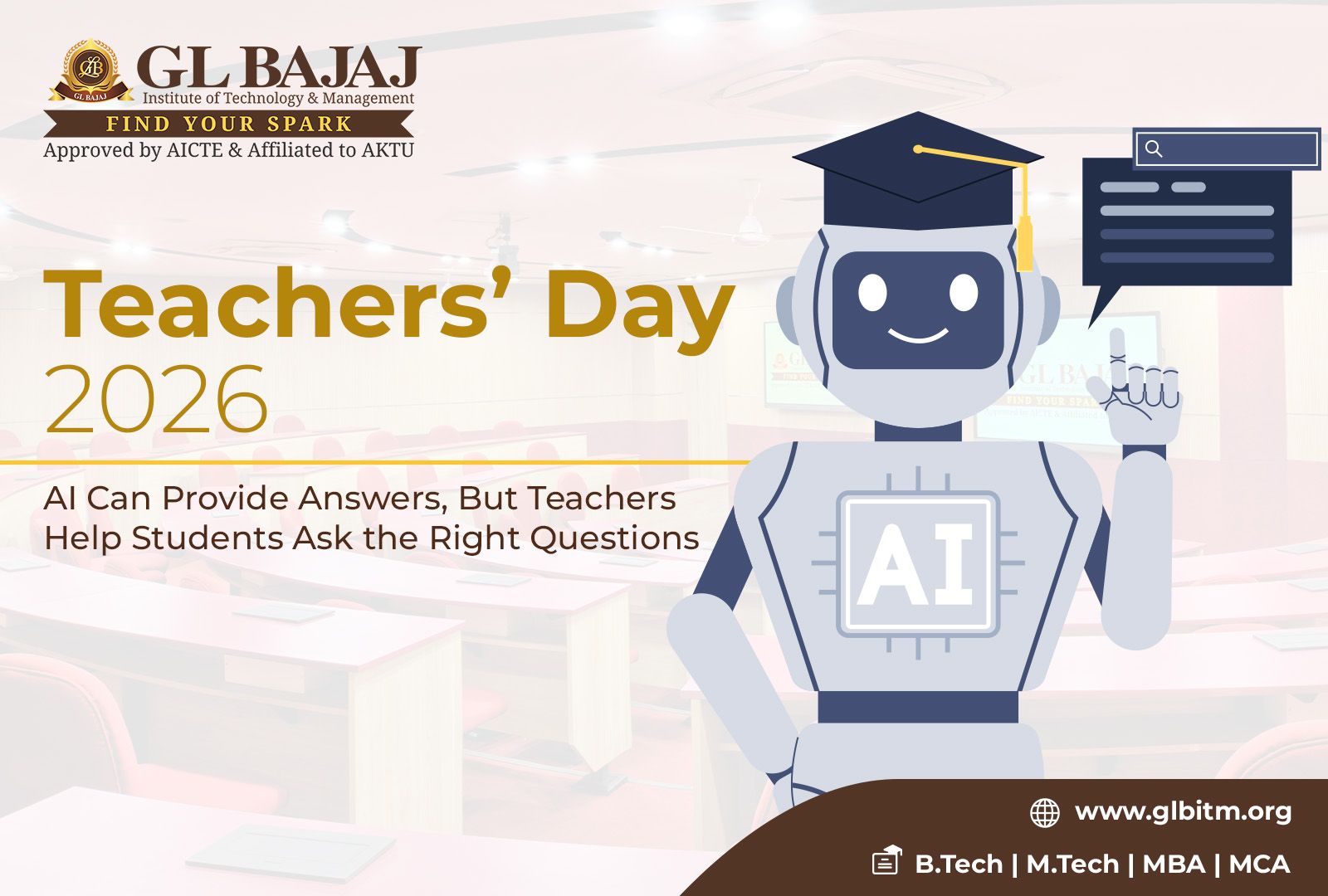
AI may become better at answering questions, but teachers help students understand which questions are worth asking.
That is the deeper role of teachers in the age of AI.
Their role is evolving from delivering information to building critical thinking, confidence, values, and responsible technology use.
This Teachers’ Day, the question should not be, “Will AI replace teachers?” but, “How can AI help teachers create better learning experiences?” The future of education will belong to those who bring technology and human guidance together.
At GL Bajaj, we believe learning is strongest when innovation meets mentorship. Let’s build a future where technology supports learning and teachers inspire it.
