What if an engineering classroom could become the starting point for a real startup?
Today, engineering education is moving beyond textbooks, giving students opportunities to solve problems, build ideas, and understand the world of work.
A recent achievement at GL Bajaj reflects this changing approach.
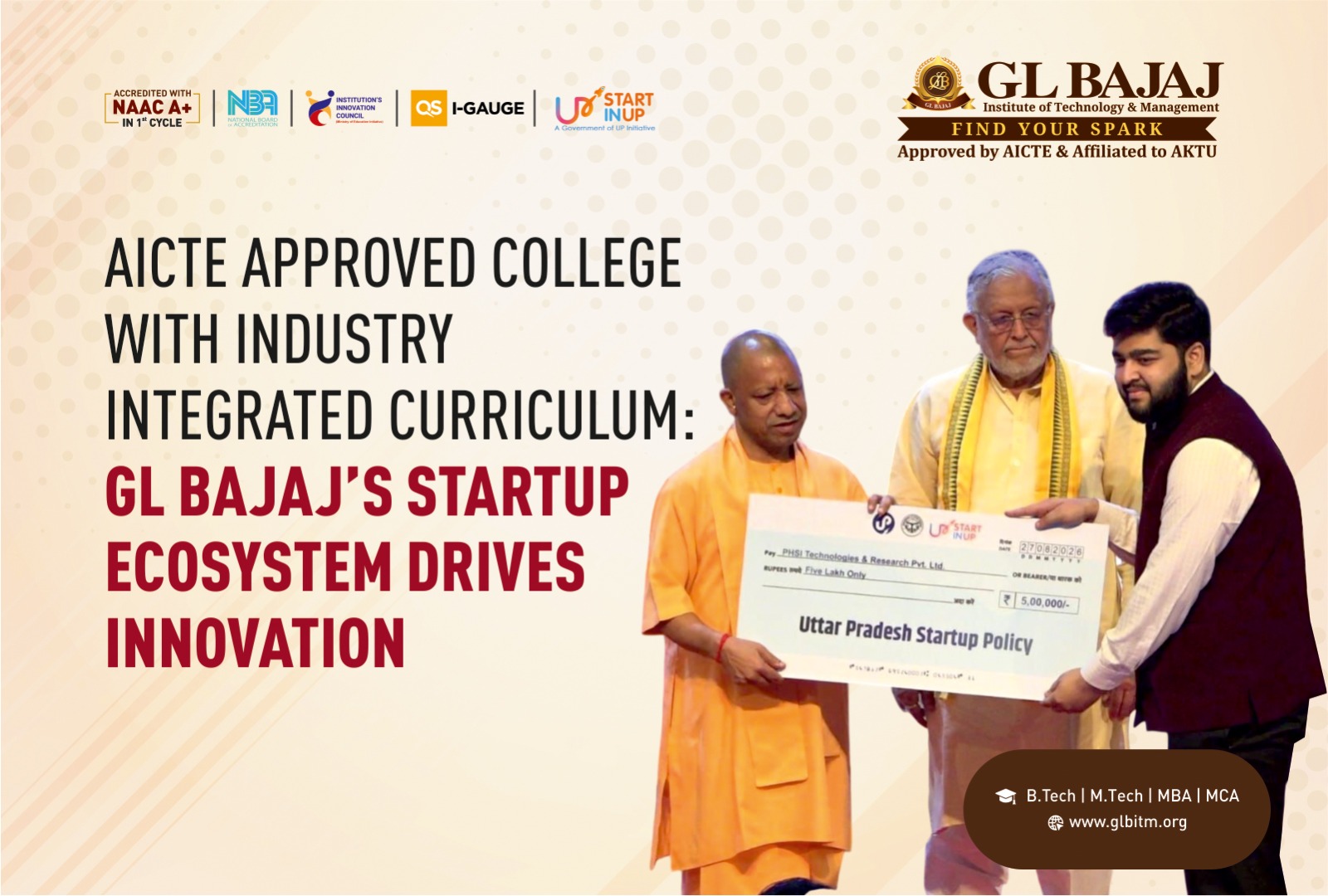
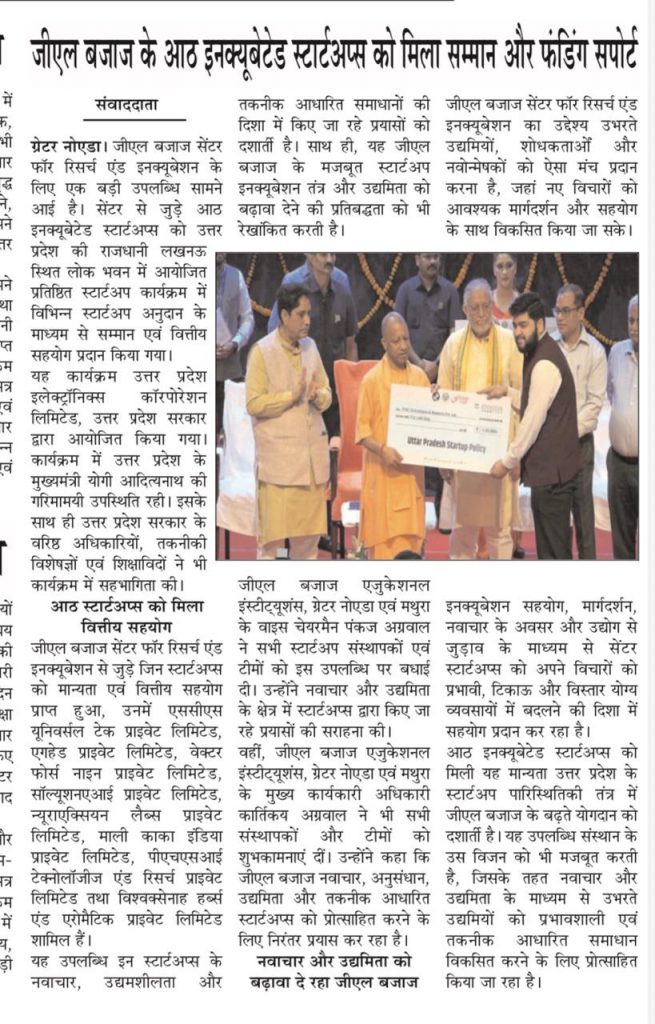
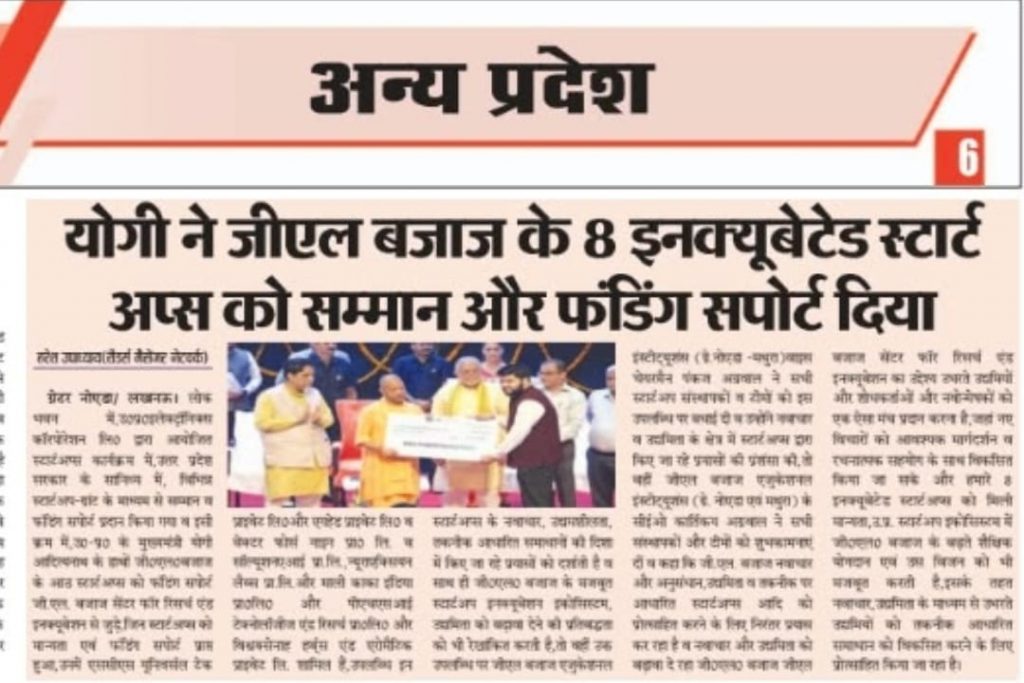
Eight startups incubated through the GL Bajaj Center for Research and Incubation received recognition and funding support at an event held at Lok Bhawan, Lucknow.
The achievement highlights the value of an AICTE-Approved College, where an Industry-Integrated Curriculum can connect academic knowledge with practical learning, innovation, entrepreneurship, and industry needs.
Eight GL Bajaj Incubated Startups Receive Recognition and Funding Support
The Lucknow event marked a significant moment for the GL Bajaj startup ecosystem, with Hon’ble Chief Minister of Uttar Pradesh Shri Yogi Adityanath present at the programme held at Lok Bhawan, Lucknow.
Organised by U.P. Electronics Corporation Limited (UPLC), Government of Uttar Pradesh, the event brought together government officials, technology leaders and academic representatives.
Eight startups incubated through the GL Bajaj Center for Research and Incubation received recognition and funding support during the event. The recognised startups include:
- SCS Universal Tech Private Limited
- Egghead Private Limited
- Vector Force Nine Private Limited
- SolutionAI Private Limited
- NeuraXion Labs Private Limited
- Mali Kaka India Private Limited
- PHSI Technologies and Research Private Limited
- Vishvaksenah Herbs and Aromatic Pvt. Ltd.
The recognition highlights the innovative work and entrepreneurial efforts of these startups and reflects the growing role of incubation in supporting technology-driven ventures.
From Incubation Support to Startup Recognition
A startup often begins with an idea aimed at solving a real problem.
Turning that idea into a working venture requires research, experimentation, guidance and continuous improvement.
An incubation ecosystem can provide founders with a structured environment to develop and refine their ideas.
The recognition of these eight startups in the presence of Shri Yogi Adityanath adds significance to their achievement.
It also highlights the importance of institutional support in strengthening innovation and entrepreneurship in Uttar Pradesh.
For students, such developments demonstrate how technical knowledge, practical skills, and innovative thinking can move beyond the classroom and contribute to entrepreneurial opportunities.
Why an AICTE Approved College Needs More Than Classroom Learning
An AICTE Approved College gives students a strong academic foundation, but real learning goes beyond textbooks.
Projects allow students to apply concepts, test ideas, and solve practical problems.
Whether working with AI, software, electronics or data, students learn through implementation.
This approach strengthens problem-solving, teamwork, communication, analytical thinking and project management, helping students understand how classroom knowledge can be applied to real-world challenges.
Turning Engineering Knowledge into Practical Solutions
Suppose students identify a problem related to education, healthcare, transportation, or business operations.
Instead of only discussing the problem in class, they can research it, design a solution, and create a prototype.
This process connects theory with practice. It can also help students understand whether their idea has real-world potential.
How an Industry Integrated Curriculum Can Support Innovation
An Industry Integrated Curriculum aims to create stronger connections between academic learning and practical industry requirements.
This approach may include industry interaction, practical projects, expert sessions, internships, workshops, technology-based assignments and real-world problem statements.
The objective is not simply to add more activities to a student’s schedule.
The real value comes when students understand why they are learning something and where that knowledge can be applied.
Industry-oriented learning can also help students understand professional expectations before they enter the workplace.
Connecting Classroom Concepts with Industry Problems
A classroom concept becomes more meaningful when students can see its practical use.
For example, a programming concept taught during an academic course can later be used to develop a software application.
Similarly, knowledge of artificial intelligence can be applied to build a model that addresses a practical problem.
This connection is one of the key benefits of an Industry Integrated Curriculum. It encourages students to think beyond examinations and consider how their skills can create solutions.
GL Bajaj Center for Research and Incubation: Creating Space for Entrepreneurs
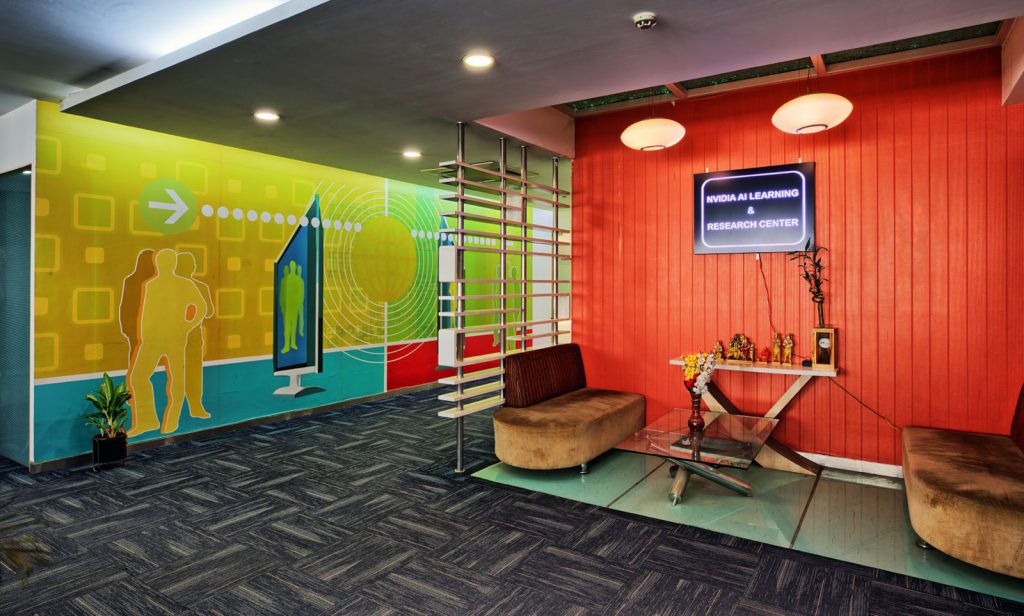
The GL Bajaj Center for Research and Incubation focuses on creating an environment where innovative ideas can develop into ventures.
Incubation support can be valuable for founders because developing a startup involves more than creating a product.
Entrepreneurs also need to understand the problem they are solving, refine their ideas and think about long-term sustainability.
The Centre’s focus on incubation, mentorship, innovation and growth opportunities contributes to a wider environment for entrepreneurship.
The recognition of eight startups at the Lucknow event provides a visible example of this ecosystem in action.
What This Achievement Means for Students
The success of incubated startups can also provide an important learning opportunity for students.
Engineering is often associated with careers in established companies. However, technical knowledge can also be used to create products, develop solutions, conduct research or build new ventures.
An AICTE Approved College with opportunities for innovation can expose students to these different possibilities.
Students can learn from startup journeys by observing how an idea develops, how teams work together and how technology can be used to address real problems.
Learning from Founders Can Shape Student Thinking
Exposure to entrepreneurship can encourage students to look at problems differently.
Instead of asking only, “Which job can I get after graduation?”, students may also begin asking, “Which problem can I solve?”
This change in thinking can support creativity, initiative and problem-solving.
It does not mean every student needs to become an entrepreneur.
Rather, entrepreneurial exposure can strengthen skills that are useful across many professional careers.
Personal Experience: What I Look for in an Engineering College
When I evaluate an engineering college, I do not think the course name should be the only deciding factor.
I would also look at what students can actually do with what they learn.
A classroom can explain a technical concept.
But practical projects can show students how that concept works. Industry interaction can help them understand professional expectations.
Startup incubation can show them how technical ideas can potentially become real solutions.
This is why I would look for a combination of academic learning, practical exposure, industry interaction, and innovation opportunities.
The recognition received by eight GL Bajaj incubated startups makes this aspect particularly relevant.
It shows that the institution’s innovation ecosystem extends beyond conventional classroom education and includes support for emerging ventures.
For me, this is an important point when assessing an AICTE Approved College.
The question should not only be whether students learn technical subjects, but also whether they receive opportunities to apply that knowledge.
How Startup Incubation Strengthens an Industry Integrated Curriculum
An Industry Integrated Curriculum becomes more valuable when students can connect their learning with real innovation.
The progression can be simple:
Academic foundation → Practical learning → Industry exposure → Innovation → Incubation → Startup development
Students first develop technical knowledge.
They then apply it through projects and practical activities.
Industry exposure can introduce them to real-world requirements.
Innovation opportunities can encourage them to develop solutions, while incubation can provide a structured environment for promising ideas.
This creates a connection between education and entrepreneurship.
From Student Projects to Entrepreneurial Ideas
Not every student project becomes a startup, and it should not. However, some projects may identify genuine problems or demonstrate innovative solutions.
With the right guidance, such ideas can be refined further.
This is where incubation can play an important role. It can provide an environment where founders and innovators can work on their ideas with greater structure and direction.
GL Bajaj’s Contribution to Uttar Pradesh’s Startup Ecosystem
The recognition of eight incubated startups at Lok Bhawan, Lucknow, also places the achievement within the larger startup ecosystem of Uttar Pradesh.
Mr. Pankaj Agarwal, Vice Chairman, GL Bajaj Educational Institutions (Greater Noida and Mathura), congratulated the founders and teams for their achievement and appreciated their contribution to innovation and entrepreneurship.
Mr. Kartikay Agarwal, CEO, GL Bajaj Educational Institutions (Greater Noida and Mathura), also congratulated the startups and reaffirmed GL Bajaj’s commitment to innovation, entrepreneurship, research, and technology-driven startups.
Such initiatives can help educational institutions contribute to a culture where students and founders are encouraged to develop ideas and work on practical challenges.
What Students Should Look for Beyond the College Name
When evaluating an AICTE Approved College, students can use a simple checklist rather than focusing only on rankings or promotional claims.
| Factor | What Students Should Check |
| Academic foundation | Recognition and approved programmes |
| Curriculum | Practical and industry relevance |
| Industry exposure | Projects, experts, internships and collaborations |
| Innovation | Research and innovation opportunities |
| Entrepreneurship | Incubation and mentorship support |
| Student development | Projects, competitions and practical activities |
| Outcomes | Verifiable achievements and initiatives |
This approach can help students make a more informed assessment of an institution.
Conclusion
The recognition and funding support received by eight GL Bajaj incubated startups in Lucknow represents more than a startup achievement.
It also highlights the role an educational institution can play in supporting innovation and entrepreneurship.
For students, the larger lesson is simple.
Engineering education becomes more meaningful when knowledge moves beyond the classroom and finds a place in real problems, practical solutions and innovation.
An AICTE Approved College can provide the academic foundation students need, while an Industry Integrated Curriculum can help connect that foundation with practical applications.
The GL Bajaj Center for Research and Incubation adds another dimension by creating opportunities for innovative ideas and startups to receive structured support.
Ultimately, the goal of modern engineering education should not be limited to preparing students to learn.
It should also encourage them to apply, create, innovate and solve problems.
