What if your safety app could warn you before danger, not after it?
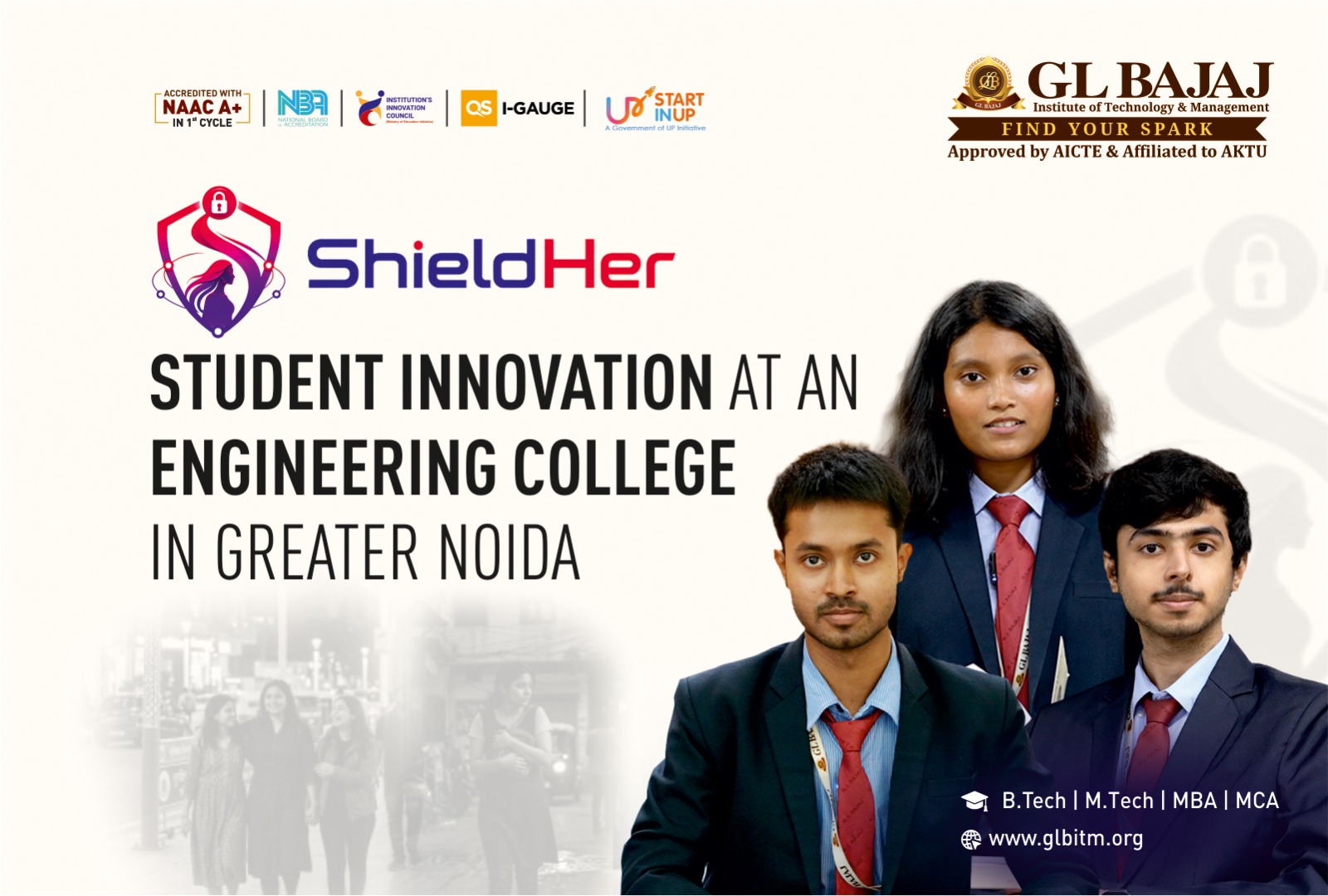
That bold question sparked ShieldHer, a Predictive Urban Safety Intelligence project created by Team Code Crafters at G.L. Bajaj Institute of Technology and Management, Greater Noida.
The team includes three B.Tech CSE students from the 2024to 2028 batch: Harshit Gupta, Hemani Majhi and Janesh.
Unlike traditional safety systems that react after an incident, ShieldHer is designed to identify unusual behaviour and changing risk signals earlier.
By combining AI, machine learning, maps and real-time software signals, the project aims to support proactive safety.
For these students, it became more than a project; it became a way to turn classroom learning into a meaningful real-world solution.
The Question That Started ShieldHer
Every innovation begins with a problem worth solving.
For Team Code Crafters, ShieldHer began with one simple concern: most safety systems react after danger appears.
The students asked, “What about the warning signs that come before an emergency?”
A sudden stop, an unexpected route change, an isolated location or low crowd activity may seem harmless alone.
But together, they may signal a changing situation.
The team wanted to build a system that could identify such unusual patterns and support an earlier response.
That idea became the foundation of ShieldHer.
From a Safety Concern to a Technology Idea
Turning an idea into a working prototype takes more than writing code.
The team first had to think about what could indicate a possible change in risk.
They considered several signals:
- Behavioural changes
- Route deviations
- Time of day
- Isolation
- Crowd activity
- Location
The next challenge was bringing these signals together.
The students designed ShieldHer around four simple steps:
Detect → Assess → Score → Respond
This structure helped Team Code Crafters turn their initial idea into a working prototype.
How ShieldHer Works

ShieldHer uses a four-stage pipeline to assess changing safety conditions.
1. Detecting Unusual Behaviour
The first step is to identify behaviour that appears different from a normal pattern.
ShieldHer uses an Isolation Forest machine learning model for this purpose.
In simple words, the model looks for behaviour that stands out.
- Sudden stops
- Route changes
- Unusual movement patterns
- Behavioural deviation
The system does not need to rely only on pre-labelled examples. This makes unsupervised anomaly detection useful for the prototype.
For the B.Tech CSE students, this was an opportunity to apply a machine learning concept to a practical problem.
2. Checking Risk Zone by Zone
The next step is to understand the surrounding area.
ShieldHer uses a Dynamic Micro-Zone Risk Engine to assess different areas.
The working prototype monitors 847+ zones across Greater Noida through an interactive map.
The risk level can change based on factors such as:
- Time of day
- Isolation level
- Crowd signals
This approach is different from depending only on a fixed safety map.
A location can have different conditions at different times. ShieldHer is designed to account for these changing signals.
3. Turning Multiple Signals Into One Score
Safety analysis can involve many data points.
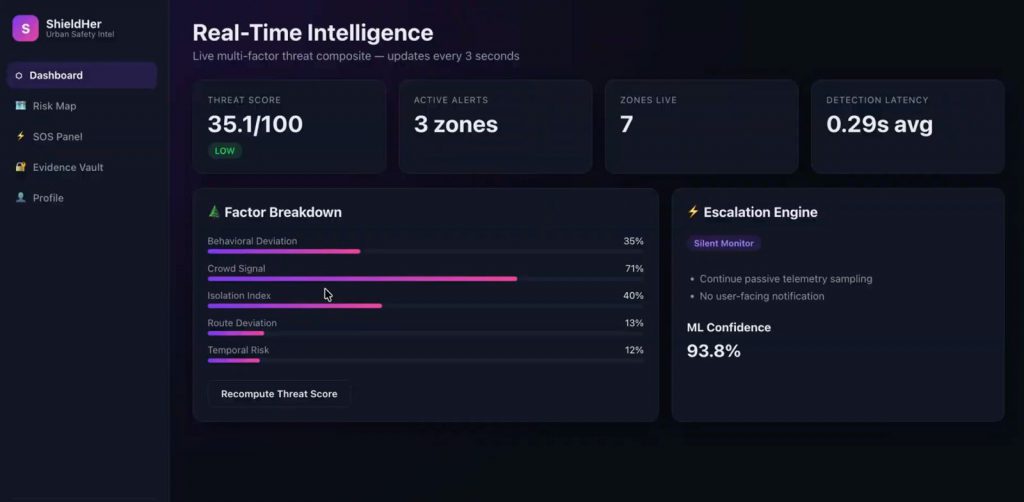
ShieldHer combines these signals into a Multi-Factor Threat Probability Score ranging from 0 to 100.
The score considers:
- Behavioural deviation
- Isolation index
- Temporal risk
- Crowd signals
- Route deviation
The idea is simple.
Instead of requiring a user to understand many separate signals, the system presents a single risk score.
This makes the information easier to understand at a glance.
4. Responding in Stages
Not every unusual situation requires the same response.
ShieldHer uses a gradual escalation model:
Silent monitoring → Vibrate alert → Location sharing → Emergency dispatch
The response can increase as the risk level changes.
The prototype also includes a 2.5-second SOS hold.
When the SOS protocol is activated, the system can begin its full emergency process. It can also capture evidence and record the incident in a secure evidence system.
This staged approach is one of the key ideas behind ShieldHer.
The AI and Technology Behind ShieldHer
ShieldHer brings several technologies together to create its prototype.
Isolation Forest
Isolation Forest is used for unsupervised anomaly detection.
In simple terms, it helps identify patterns that look unusual.
Scikit-learn
The team uses Scikit-learn as the machine learning implementation layer.
It supports the development and use of the project’s machine learning model.
React
The frontend is developed using React.
It provides the interface through which users can interact with the system.
Python and Flask
The backend uses Python and Flask.
These technologies support the application’s backend functions.
Firebase
Firebase is used for:
- Realtime Database
- Authentication
Maps and Location
The project uses:
- Leaflet.js
- OpenStreetMap
- Google Maps API
These technologies support the interactive map and location-related features.
A Safety System Designed to Be Predictive
The main idea behind ShieldHer is the shift from reactive safety to predictive safety.
A traditional approach can look like:
Incident → Alert → Response
ShieldHer is designed around:
Signals → Risk Analysis → Score → Response
For example, imagine someone travelling through an isolated area late at night.
Their route suddenly changes.
The area has low crowd activity.
The movement pattern also becomes unusual.
ShieldHer can bring these signals together and calculate a changing risk score.
This does not mean the system knows that a crime will happen.
Instead, it is designed to identify a combination of signals that may suggest increased risk.
That distinction is important.
ShieldHer is a prototype designed for proactive risk assessment, not a guarantee of future events.
Inside Team Code Crafters
Behind ShieldHer are three B.Tech CSE students who brought different ideas and skills to one project.
| Student Name | Batch | Branch | Roll No. |
| Harshit Gupta | 2024-2028 | B.Tech CSE | 240192010054 |
| Hemani Majhi | 2024-2028 | B.Tech CSE | 2401920100156 |
| Janesh | 2024-2028 | B.Tech CSE | 2401920100163 |
Together, they formed Team Code Crafters and developed ShieldHer.
For the students, the project offered a chance to move beyond theory.
They had to think about a real problem, understand possible solutions, select technologies, and build a prototype that could bring their idea to life.
What the B.Tech CSE Students Learned
A project like ShieldHer can teach lessons that go beyond programming.
A Good Project Starts With a Real Problem
The team did not start with AI simply because AI is popular.
They started with a safety concern.
Then they looked at how technology could help.
That approach helped them connect their technical knowledge with a real-world problem.
Technology Needs Purpose
React, Python, machine learning, and maps are only tools.
The real value comes from how these tools are used.
Team Code Crafters used them to create a system around predictive safety.
Teamwork Matters
Building a complete project requires more than individual technical skills.
The students had to work together, share ideas, and solve development challenges.
This kind of experience can help B. Tech CSE students understand how real technology projects are built.
Prototypes Need Improvement
A working prototype is a starting point.
Testing and feedback are needed to understand how well each part of the system performs.
For ShieldHer, future testing can help the team improve the model and the overall user experience.
From Classroom Learning to Xen-o-Thon 2026
ShieldHer was developed as part of Xen-o-Thon 2026 under the Open Track at the national level.
For Team Code Crafters, the event provided an opportunity to take their idea from concept to prototype.
The journey was not simply about coding.
It involved:
Idea → Research → Development → Testing → Improvement → Presentation
This is where practical engineering education becomes important.
Students learn how to apply concepts instead of only studying them.
A classroom lesson about machine learning can become a working model.
A programming lesson can become an application.
A problem discussed in a group can become a project.
That is the journey Team Code Crafters experienced through ShieldHer.
Faculty Mentorship Behind the Project
ShieldHer was developed with guidance from Dr. Sansar Singh Chauhan, Head of Department, Computer Science and Engineering, along with the CSE Department faculty at G.L. Bajaj Institute of Technology and Management.
Faculty guidance can help students move through the different stages of a technical project.
From refining an idea to understanding technical challenges, mentorship can help students approach development in a more structured way.
For Team Code Crafters, this support formed an important part of their project journey.
Engineering education goes beyond classrooms and textbooks.
Why Projects Like ShieldHer Matter at an Engineering College in Greater Noida
Today, students learn and apply skills in artificial intelligence, machine learning, data science, cloud computing, web development, cybersecurity and software engineering.
Practical projects give them a chance to turn these skills into useful solutions.
At an Engineering College in Greater Noida, such experiences can help students connect academic learning with real-world challenges.
ShieldHer is one example of how B.Tech CSE students can apply classroom concepts to build a meaningful technology prototype.
While the final product matters, the journey of learning, testing, teamwork, and problem-solving matters just as much.
What Makes ShieldHer Different?
ShieldHer brings several features together in one predictive safety concept.
1. Behaviour Detection
ShieldHer uses an Isolation Forest model to identify unusual behavioural patterns in real time.
It can detect signals such as sudden stops, unexpected route deviations, or movement changes without depending on labelled datasets or continuous GPS tracking, helping identify potential risks at an early stage.
2. Dynamic Risk Zones
The Dynamic Micro-Zone Risk Engine continuously evaluates safety conditions across 847+ zones in Greater Noida.
It considers factors such as time of day, isolation levels, movement patterns, and crowd signals to update zone-level risk, helping the system respond to changing conditions rather than relying on static safety maps.
3. Live Risk Score
ShieldHer converts multiple safety indicators into a single Multi-Factor Threat Probability Score ranging from 0 to 100.
Behavioural deviation, isolation, temporal risk, crowd signals, and route deviation are combined to provide a simple, glanceable representation of the user’s current risk level.
4. Staged Escalation
The Smart Escalation Engine enables ShieldHer to respond proportionally as risk increases.
Instead of immediately triggering an emergency response, the system can progress from silent monitoring to vibration alerts, location sharing, and emergency dispatch, reducing unnecessary escalation while providing stronger support when the situation demands it.
5. SOS Activation
ShieldHer includes a dedicated SOS mechanism designed for deliberate emergency activation.
Holding the SOS panel for 2.5 seconds activates the complete emergency protocol, helping prevent accidental triggers while enabling the system to initiate the predefined safety response when the user intentionally requests immediate assistance.
6. Evidence Capture
During SOS activation, ShieldHer can initiate a silent camera capture feature to collect photo evidence related to the incident.
The feature is designed to operate discreetly, supporting the creation of potentially useful incident records while keeping the evidence-generation process integrated within the emergency response workflow.
7. Secure Evidence Storage
ShieldHer stores SOS-related evidence in an AES-256 encrypted Evidence Vault designed to strengthen data security.
A tamper-proof hash chain is also used to help preserve evidence integrity, creating an additional layer of protection against unauthorized alteration of incident records after they have been captured.
8. The Predictive Safety Approach
Together, these features support ShieldHer’s central objective: identifying potential safety risks before they become incidents.
By combining behavioural analysis, dynamic zone intelligence, live risk scoring, staged escalation, SOS activation, evidence capture, and secure storage, the prototype moves safety support from reactive response toward proactive intervention.
A Project Built With a Human Purpose
Technology can sometimes feel distant from everyday life.
Code runs in the background.
Models process information.
Maps display data.
But ShieldHer brings those technologies back to a human question:
How can technology help people feel safer?
That question shaped the project from the beginning.
For Team Code Crafters, the aim was not simply to create another application.
They wanted to create something that could understand changing conditions and support people before a situation becomes an emergency.
That human purpose is what gives the project its identity.
What Comes Next for ShieldHer?
ShieldHer is currently a working prototype.
The next stage is further testing and validation.
The team can evaluate areas such as:
- Model performance
- Prediction quality
- False alerts
- Different user situations
- Larger datasets
- Wider geographic conditions
The project’s accuracy and detailed testing results are yet to be added by the team.
These figures should be included once verified testing data is available.
This step is important.
A technology project should not only demonstrate features. It should also show how those features perform when tested.
Beyond a Hackathon: The Bigger Idea
ShieldHer may have started as a project for Xen-o-Thon 2026, but its idea goes beyond a hackathon.
It reflects a different way of thinking about safety. Instead of asking only, “What should happen after an emergency?”, the team asked, “What signals can we identify before it reaches that stage?”
This shift led them to explore AI, machine learning, location intelligence and smart escalation.
Three students. One team. One problem. One prototype.
Team Code Crafters and ShieldHer show how student ideas can become meaningful technology through practical learning and innovation.
Frequently Asked Questions About ShieldHer
1. What is ShieldHer?
ShieldHer is a Predictive Urban Safety Intelligence prototype developed by Team Code Crafters, comprising three B.Tech CSE students from G.L. Bajaj Institute of Technology and Management.
2. Who developed ShieldHer?
ShieldHer was developed by Harshit Gupta, Hemani Majhi and Janesh, B.Tech CSE students from the 2024–2028 batch.
3. What is Team Code Crafters?
Team Code Crafters is the student team behind the ShieldHer project at G.L. Bajaj Institute of Technology and Management.
4. Which technologies are used in ShieldHer?
The project uses React, Python, Flask, Firebase, Isolation Forest, Scikit-learn, Leaflet.js, OpenStreetMap and Google Maps API.
5. How does ShieldHer detect unusual behaviour?
ShieldHer uses an Isolation Forest model for unsupervised anomaly detection. It looks for behaviour that appears unusual compared with the normal pattern.
6. How does ShieldHer calculate risk?
It combines behavioural deviation, isolation, time, crowd signals and route deviation into a Multi-Factor Threat Probability Score from 0 to 100.
7. How many zones does the prototype monitor?
The working prototype monitors 847+ zones across Greater Noida.
8. Does ShieldHer use external hardware sensors?
No. The prototype relies on software-based signals such as device behaviour, location and time.
9. What is the SOS activation process?
The prototype uses a 2.5-second hold to activate its full SOS protocol.
10. Where was ShieldHer developed?
ShieldHer was developed by Team Code Crafters at G.L. Bajaj Institute of Technology and Management and presented as part of Xen-o-Thon 2026 under the Open Track at the national level.
From B.Tech CSE Classroom to Real World Innovation
Can safety technology act before an emergency instead of only after it?
Three B.Tech CSE students, Harshit Gupta, Hemani Majhi and Janesh, turned this question into a working prototype as Team Code Crafters at G.L. Bajaj Institute of Technology and Management, Greater Noida.
By combining machine learning, software development, mapping technology and smart alerts, they developed ShieldHer, a predictive urban safety concept.
The prototype still needs further testing, but its journey shows how practical learning can turn classroom concepts into innovation.
At GL Bajaj, such projects encourage students to think like problem-solvers and future entrepreneurs.
Have an idea that can make a difference? Start building it.
