Sometimes, students do not need another lecture or another deadline. They simply need a space where they can express what they are feeling.
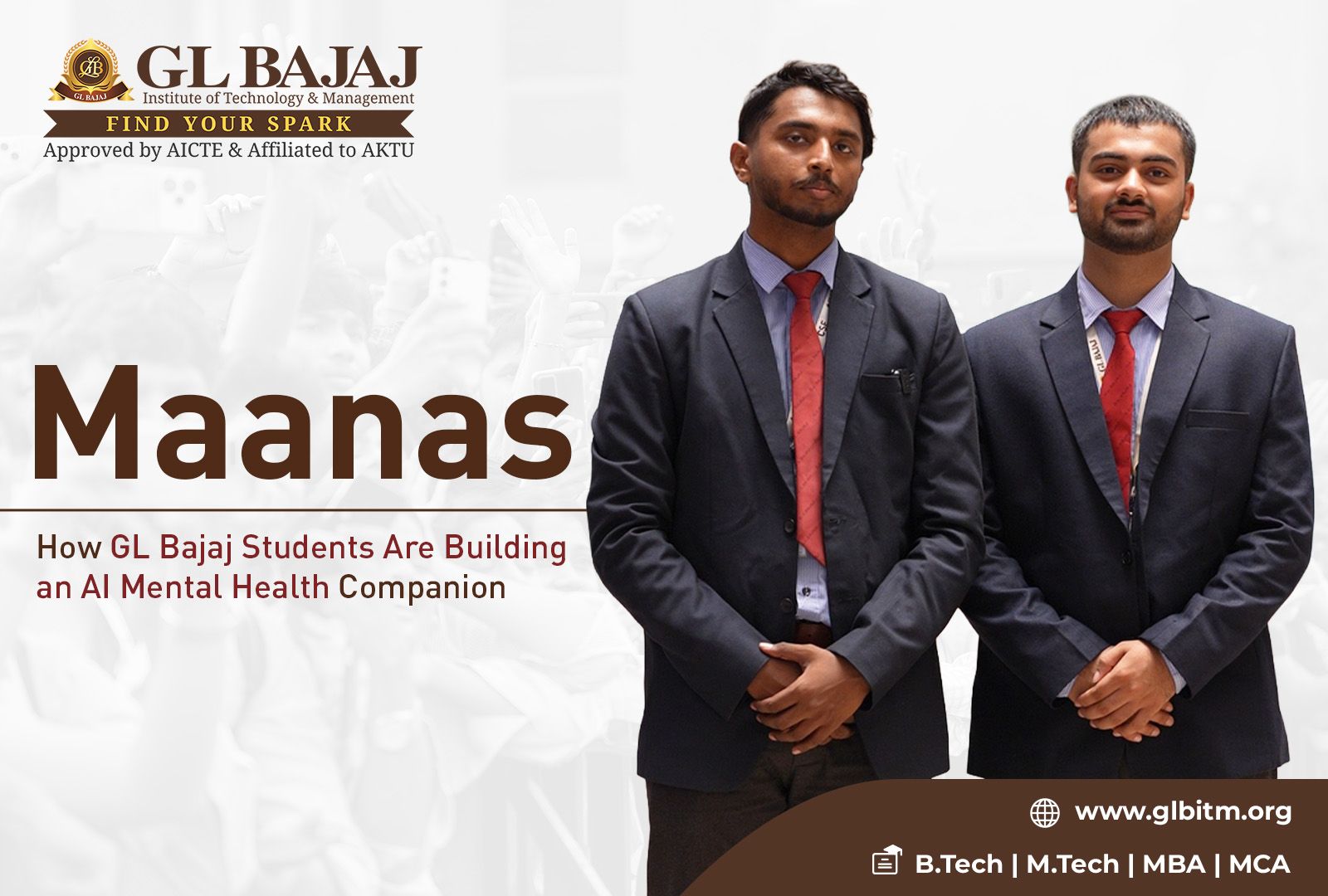
This simple thought is at the heart of Maanas Your Mental Health Companion, a student project developed by Ayush Kumar and Bhavishya Plawat, CSE students in their 5th semester at GL Bajaj Institute of Technology & Management.
The project brings together Artificial Intelligence, Natural Language Processing, conversational AI and web technologies.
More importantly, it starts with a real student problem and asks how technology can make the first step towards support easier.
The Idea Behind Maanas Started With a Real Problem
College life brings many experiences. Students manage classes, projects, examinations, deadlines and career plans.
At the same time, personal challenges can also affect their daily lives.
Talking about these challenges is not always easy.
Some students may hesitate to discuss their concerns openly. Professional counselling may not always be immediately accessible.
Institutions also need ways to understand broader student wellbeing without exposing personal information.
This is where the idea of Maanas comes in.
The project aims to provide a privacy-focused first-line support system through an AI companion.
When additional help may be needed, users can also connect with professional counsellors.
As I looked at the idea behind Maanas, what stood out was its starting point. It was not simply a project built to demonstrate AI.
It was an attempt by two CSE students to apply technology to a problem that people often find difficult to discuss.
Meet Maanas, Your Mental Health Companion
Maanas is an AI-powered platform designed to support conversations around mental wellbeing.
The project was developed by:
- Ayush Kumar
- Bhavishya Plawat
- Branch: Computer Science and Engineering
- Semester: 5th Semester
The platform combines conversational AI with wellbeing-related analysis.
Users can interact with the AI companion, receive supportive responses and access relevant resources.
The system is also designed to connect users with human counsellors when professional support may be appropriate.
This makes Maanas more than a simple question-and-answer chatbot.
Its concept focuses on conversation, patterns, resources and access to human support.
How Does Maanas Work?
The basic idea behind Maanas can be understood in three simple steps.
1. Students Start a Conversation
Users interact with the Maanas AI companion through conversation.
The system processes the user’s language and responds with relevant and supportive information.
The goal is to make the first interaction simple and accessible.
2. AI Looks at Wellbeing Signals
Maanas uses technologies such as Natural Language Processing, sentiment analysis and emotion analysis.
These technologies can help the system understand patterns in conversations.
The purpose is not to provide a medical diagnosis. Instead, the project aims to identify changes in wellbeing-related signals and provide suitable support or resources.
3. Human Support Can Be Added
AI cannot replace professional mental-health care.
Maanas therefore includes a human-support layer. Users can connect with or book sessions with professional counsellors when required.
This combination of AI assistance and human support is an important part of the project’s concept.
What Makes Maanas Different From a Regular Chatbot?
A regular chatbot may be designed to answer questions or complete specific tasks.
Maanas has a different purpose.
It is designed around student wellbeing and supportive conversations.
- AI-based conversations
- Sentiment analysis
- Emotion analysis
- Personalized resources
- Counsellor access
- Wellbeing trend analysis
- Privacy-focused support
- Human intervention
This gives the project a clear human-centred direction.
While reading about Maanas, I found this part particularly interesting.
The students are not using AI simply because it is a popular technology.
They are connecting it with a problem where communication and accessibility matter.
The Technology Behind Maanas
Maanas combines several AI and software technologies.
Generative AI
Generative AI helps the system create conversational responses.
Instead of relying only on fixed answers, the AI can process the context of a conversation and generate relevant responses.
Natural Language Processing
Natural Language Processing, or NLP, helps computers process human language.
For Maanas, NLP forms an important part of understanding user conversations.
Conversational AI
Conversational AI allows users to interact with the system in a more natural way.
The interaction is designed around conversation rather than a traditional form-based interface.
Sentiment and Emotion Analysis
Sentiment and emotion analysis can help identify patterns within conversations.
For Maanas, these signals can contribute to understanding changes in a user’s wellbeing-related interactions over time.
Built With the MERN Stack
Maanas also demonstrates how modern web technologies can support an AI-based application.
The project uses the MERN stack, which includes:
| Technology | Role in the Project |
| MongoDB | Database management |
| Express.js | Backend framework |
| React.js | User interface |
| Node.js | Server-side development |
| Gemini | AI/LLM API integration |
| Grok | AI/LLM API integration |
Node.js is used for backend and server-side development. It also supports the integration of AI and LLM services.
For CSE students, this means the project brings together multiple areas of technical learning in one application.
Privacy Is Part of the Idea
Mental wellbeing is a sensitive area. Privacy therefore plays an important role in the Maanas concept.
The platform is designed around privacy and anonymity.
Individual student information should not become visible through an institutional dashboard simply because students use the platform.
Instead, the project includes an anonymized admin/dean dashboard.
This dashboard is designed to provide aggregate mental-health trends without exposing individual user information.
The idea is simple:
Support the student without unnecessarily exposing the student.
Anonymized Dashboard for Institutions
The institutional side of Maanas adds another layer to the project.
A college may need to understand broader student wellbeing trends. However, that does not mean individual conversations should be exposed.
Maanas aims to provide aggregate insights through an anonymized dashboard.
For example, institutions could potentially identify broader changes in wellbeing-related trends and use those insights to consider additional support measures.
The focus remains on trends rather than individual identities.
What Can Students Do With Maanas?
The project brings several features together on one platform.
AI Mental Health Companion
Students can interact with an AI-powered companion through natural conversations.
The platform is designed to provide an accessible first-line support system, helping students express concerns, reflect on their feelings, and receive appropriate guidance.
Personalized Resources
The platform can provide personalized resources based on the context of each interaction.
These resources may include relevant wellbeing information, self-help guidance, practical suggestions, and supportive content suited to individual student needs.
Counsellor Session Booking
When professional support may be appropriate, students can use the platform to connect with counsellors.
The counsellor session booking feature creates a bridge between digital support and human guidance for students seeking further assistance.
Wellbeing Trend Analysis
The system can analyze wellbeing-related signals over time to identify patterns and changes.
This feature can help students understand their overall wellbeing while providing institutions with broader, privacy-conscious insights into student support needs.
Privacy-Focused Support
Privacy is an important part of the Maanas concept.
The platform focuses on protecting individual information and supporting anonymous interactions, allowing students to discuss personal concerns while maintaining greater control over their information.
Human Intervention
The system can help identify situations where additional human support may be appropriate.
In such cases, it can encourage students to connect with professional counsellors or other suitable human support instead of relying only on AI.
What Makes Maanas a Predictive AI Project?
One of the interesting aspects of Maanas is its predictive element.
The project can analyze conversations and wellbeing-related signals over time.
The basic process can be viewed as:
Conversation → Signals → Patterns → Changes → Suggested Support
For example, repeated changes in wellbeing-related signals may indicate that additional support could be useful.
The project is therefore focused on identifying patterns rather than making a medical diagnosis.
This distinction matters.
Maanas is designed as a support system. It is not intended to replace qualified mental-health professionals.
From a CSE Classroom to a Real-World Problem
What makes student projects valuable is the opportunity to apply classroom learning to practical problems.
Maanas brings several areas of Computer Science together.
Students working on the project need to think about:
- Programming
- Databases
- Web development
- Artificial Intelligence
- Natural Language Processing
- API integration
- User experience
- Data privacy
- Real-world problem solving
This is where engineering education becomes more practical.
Students are not only learning how a technology works. They are also learning where that technology can be applied.
Why Projects Like Maanas Matter in Engineering Education
When students search for the best engineering college, they often look at academics, infrastructure, faculty and career opportunities.
These factors matter.
But student innovation also offers another way to understand an engineering learning environment.
Projects such as Maanas allow students to move from theory to implementation.
A concept discussed in a classroom can become a working application.
A programming skill can become part of a larger solution. An AI technique can be connected to a real-world challenge.
That transition from learning to building is an important part of engineering education.
AI Skills Meet Human-Centred Innovation
Artificial Intelligence is now being used across many fields.
Students are building AI applications for education, healthcare, finance, agriculture, cybersecurity and other areas.
Maanas takes AI into another important space: student wellbeing.
The project shows how CSE students can combine technical skills with human-centred thinking.
For an engineering college in Greater Noida, such student projects can also become opportunities for learners to understand how emerging technologies work beyond textbooks.
The Students Behind Maanas
Maanas was developed by Ayush Kumar and Bhavishya Plawat, students of Computer Science and Engineering in their 5th semester.
Their project brings together web development and AI technologies to address a problem that has both technical and human dimensions.
For the students, developing Maanas means working across different parts of the technology stack.
They have to think about how users interact with the platform, how information is processed and how AI services connect with the application.
This makes the project a practical learning experience as much as a technology project.
What Maanas Tells Us About Student Innovation at GL Bajaj
A best engineering college experience is not limited to lectures and examinations.
It also includes opportunities to build, test and improve ideas.
Student projects can show how classroom concepts are being applied to real-world problems.
Maanas is one such example.
The project combines CSE skills, AI technologies and a human-centred problem into one application.
It reflects the kind of project-based learning where students can experiment with emerging technologies while working on practical challenges.
For students interested in AI and Machine Learning, projects like Maanas can also provide exposure to technologies that are increasingly becoming part of modern software development.
The Bigger Picture: Where AI Meets Student Wellbeing
The use of AI in mental wellbeing also raises important questions.
How should sensitive information be protected?
When should an AI system involve a human professional?
How can institutions use aggregate data responsibly?
How can technology support students without replacing professional care?
These questions are just as important as the technology itself.
Maanas attempts to address some of these concerns through its privacy-focused design, counsellor connection and anonymized institutional dashboard.
The project also highlights an important principle: AI should support human care, not replace it.
From a Semester Project to a Bigger Possibility
Maanas may have started as a 5th-semester CSE project.
But the idea behind it goes beyond a classroom demonstration.
It shows what can happen when students start with a real problem and ask how technology can help.
The project combines AI, NLP, conversational technology and web development. At the same time, it keeps the user at the centre of the experience.
That is perhaps what makes student innovation interesting.
Technology becomes more meaningful when students do not simply ask, “What can we build?”
They also ask:
“What problem can we solve?”
Maanas is one example of that approach.
For students looking towards an engineering college in Greater Noida, such projects also highlight the value of learning by building.
The journey from an idea to an application can help students understand technology in a way that goes beyond the classroom.
About GL Bajaj Institute of Technology & Management
GL Bajaj Institute of Technology & Management, Greater Noida, focuses on engineering and management education with emphasis on academics, innovation and practical learning.
The institute offers programmes across areas including Computer Science and Engineering and other emerging technology domains.
Through student projects, research activities and innovation initiatives, students get opportunities to work on practical ideas and apply their technical knowledge.
For aspiring engineering students, this combination of academic learning and project development can form an important part of their college experience.
Frequently
Who developed the Maanas project?
The project was developed by Ayush Kumar and Bhavishya Plawat, CSE students in their 5th semester.
What technologies are used in Maanas?
Maanas uses Generative AI, NLP, conversational AI, sentiment analysis and emotion analysis.
Which technology stack does Maanas use?
Maanas uses the MERN stack, including MongoDB, Express.js, React.js and Node.js.
Does Maanas provide mental-health diagnosis?
No. Maanas is designed as a first-line support system and does not replace professional mental-health care.
Can users connect with counsellors through Maanas?
Yes. The platform includes functionality for connecting with or booking sessions with professional counsellors.
How does Maanas use AI?
AI helps process conversations, identify wellbeing-related signals and provide supportive resources.
What makes Maanas predictive?
Maanas can analyze wellbeing-related signals over time to identify patterns and changes that may suggest additional support.
Why are student AI projects important?
Student AI projects help learners apply technical knowledge to practical problems and develop real-world solutions.
Final Thought
The most interesting part of an engineering project is not always the technology behind it.
Sometimes, it is the reason the technology was built.
Maanas brings together AI, software development and student-centred thinking to address a real challenge.
Created by two CSE students, the project shows how an idea from the classroom can grow into a solution with wider possibilities.
And perhaps that is where engineering education becomes truly meaningful, when students learn not only how to build technology, but also why they should build it.
